


Page 476 - Robot Builder's Bonanza
P. 476
ALL ABOUT MICROCONTROLLER SPEED    445


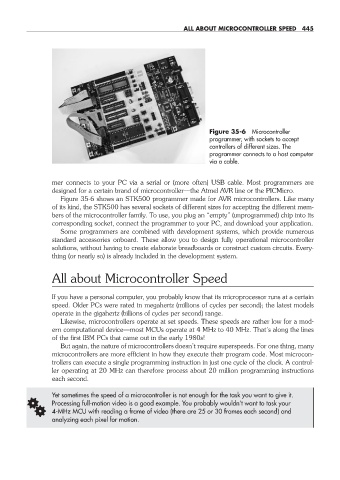
                                                               Figure 35- 6  Microcontroller
                                                               programmer, with sockets to accept
                                                               controllers of different sizes. The
                                                               programmer connects to a host computer
                                                               via a cable.


                   mer connects to your PC via a serial or (more often) USB cable. Most programmers are
                   designed for a certain brand of  microcontroller— the Atmel AVR line or the PICMicro.
                     Figure 35- 6 shows an STK500 programmer made for AVR microcontrollers. Like many
                   of its kind, the STK500 has several sockets of different sizes for accepting the different mem-
                   bers of the microcontroller family. To use, you plug an “empty” (unprogrammed) chip into its
                   corresponding socket, connect the programmer to your PC, and download your application.
                     Some programmers are combined with development systems, which provide numerous
                   standard accessories onboard. These allow you to design fully operational microcontroller
                   solutions, without having to create elaborate breadboards or construct custom circuits. Every-
                   thing (or nearly so) is already included in the development system.


                   All about Microcontroller Speed

                   If you have a personal computer, you probably know that its microprocessor runs at a certain
                   speed. Older PCs were rated in megahertz (millions of cycles per second); the latest models
                   operate in the gigahertz (billions of cycles per second) range.
                     Likewise, microcontrollers operate at set speeds. These speeds are rather low for a mod-
                   ern computational  device— most MCUs operate at 4 MHz to 40 MHz. That’s along the lines
                   of the first IBM PCs that came out in the early 1980s!
                     But again, the nature of microcontrollers  doesn’t require superspeeds. For one thing, many
                   microcontrollers are more efficient in how they execute their program code. Most microcon-
                   trollers can execute a single programming instruction in just one cycle of the clock. A control-
                   ler operating at 20 MHz can therefore process about 20 million programming instructions
                   each second.
                   Yet sometimes the speed of a microcontroller is not enough for the task you want to give it.
           G       Processing  full- motion video is a good example. You probably  wouldn’t want to task your
                   4- MHz MCU with reading a frame of video (there are 25 or 30 frames each second) and
                   analyzing each pixel for motion.


 35-chapter-35.indd   445                                                                   4/21/11   11:57 AM

