


Page 472 - Robot Builder's Bonanza
P. 472
UNDER THE HOOD OF THE TYPICAL MICROCONTROLLER CHIP    441


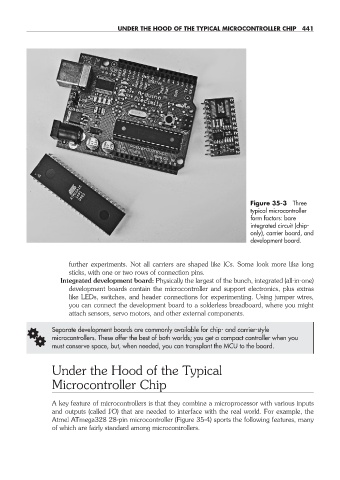
                                                                           Figure 35- 3  Three
                                                                           typical microcontroller
                                                                           form factors: bare
                                                                           integrated circuit  (chip-
                                                                           only), carrier board, and
                                                                           development board.


                       further experiments. Not all carriers are shaped like ICs. Some look more like long
                       sticks, with one or two rows of connection pins.
                     Integrated development board: Physically the largest of the bunch, integrated  (all- in- one)
                       development boards contain the microcontroller and support electronics, plus extras
                       like LEDs, switches, and header connections for experimenting. Using jumper wires,
                       you can connect the development board to a solderless breadboard, where you might
                       attach sensors, servo motors, and other external components.

           G       Separate development boards are commonly available for chip-  and  carrier- style
                   microcontrollers. These offer the best of both worlds; you get a compact controller when you
                   must conserve space, but, when needed, you can transplant the MCU to the board.


                   Under the Hood of the Typical
                   Microcontroller Chip


                   A key feature of microcontrollers is that they combine a microprocessor with various inputs
                   and outputs (called I/O) that are needed to interface with the real world. For example, the
                   Atmel ATmega328 28- pin microcontroller (Figure 35- 4) sports the following features, many
                   of which are fairly standard among microcontrollers.


 35-chapter-35.indd   441                                                                   4/21/11   11:57 AM

