


Page 309 -
P. 309
294                            Robust Control of Robotic Manipulators

            the other hand, if one can show the passivity of the system, which maps   to
            a new vector r which is a filtered version of e, a controller that closes the
            loop between -r and   will guarantee the asymptotic stability of both e and  .
            This indirect use of the passivity property was illustrated in [Ortega and
            Spong 1988] and will be discussed first.
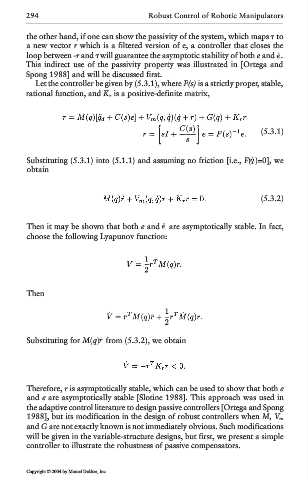
              Let the controller be given by (5.3.1), where F(s) is a strictly proper, stable,
            rational function, and K r is a positive-definite matrix,


                                                                       (5.3.1)


            Substituting (5.3.1) into (5.1.1) and assuming no friction [i.e., F( )=0], we
            obtain


                                                                       (5.3.2)


            Then it may be shown that both e and   are asymptotically stable. In fact,
            choose the following Lyapunov function:


            Then


            Substituting for M(q)  from (5.3.2), we obtain


            Therefore, r is asymptotically stable, which can be used to show that both e
            and e are asymptotically stable [Slotine 1988]. This approach was used in
            the adaptive control literature to design passive controllers [Ortega and Spong
            1988], but its modification in the design of robust controllers when M, V m
            and G are not exactly known is not immediately obvious. Such modifications
            will be given in the variable-structure designs, but first, we present a simple
            controller to illustrate the robustness of passive compensators.


            Copyright © 2004 by Marcel Dekker, Inc.

