


Page 308 -
P. 308
5.3 Nonlinear Controllers                                    293


            5.3 Nonlinear Controllers

            There is a class of robot controllers that are not computed-torque-like
            controllers. These controllers are obtained directly from the robot equations
            without using the feedback-linearization procedure. Instead, these controller
            may rely on other properties of the robot (such as the passivity of its Lagrange-
            Euler description) or may be obtained without even considering the physics
            of the robot. In general, these controllers may be written as a computed-
            torque controller with an auxiliary, nonlinear controller added to it. The
            nonlinear control term introduces coupling between the different joints
            independently from the computed-torque term. In other words, even if the
            computed-torque controller is a simple PID, the nonlinear term couples all
            joints together as will be seen in Theorems 5.3.4 and 5.3.5, for example.

            Direct Passive Controllers
            First, we present controllers that rely directly on the passive structure
            of rigid robots as described in equations (5.1.1), where   (q)-2V m (q,  )
            is skew symmetric by an appropriate choice of  V m (q,  ) as described in
            Section 3.3.


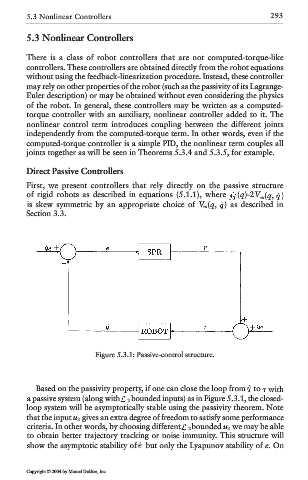
                             Figure 5.3.1: Passive-control structure.


              Based on the passivity property, if one can close the loop from   to   with
            a passive system (along with   bounded inputs) as in Figure 5.3.1, the closed-
                                     2
            loop system will be asymptotically stable using the passivity theorem. Note
            that the input u 2 gives an extra degree of freedom to satisfy some performance
            criteria. In other words, by choosing different   2 bounded u 2 we may be able
            to obtain better trajectory tracking or noise immunity. This structure will
            show the asymptotic stability of   but only the Lyapunov stability of e. On


            Copyright © 2004 by Marcel Dekker, Inc.

