


Page 81 - Robot Builders Source Book - Gordon McComb
P. 81
70                         Dynamic Analysis of Drives

           Substituting x" = D into Equation (3.27), we obtain


        Thus, Equation (3.28) can be rewritten in the form


        For initial conditions t= 0, x = x 0, and x = 0, Solution (3.30) gives


        Naturally, the initial deformation of the spring^ at the beginning of the motion must
        include the deformation caused by the force F which entails the appearance of the
        initial coordinate x 0 of the mass location.
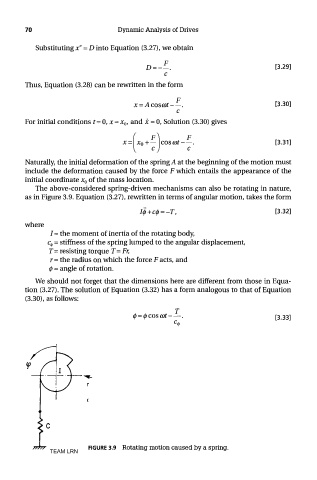
           The above-considered spring-driven mechanisms can also be rotating in nature,
        as in Figure 3.9. Equation (3.27), rewritten in terms of angular motion, takes the form


        where
               I- the moment of inertia of the rotating body,
               CQ = stiffness of the spring lumped to the angular displacement,
               T= resisting torque T= Fr,
               r = the radius on which the force F acts, and
               0 = angle of rotation.
           We should not forget that the dimensions here are different from those in Equa-
        tion (3.27). The solution of Equation (3.32) has a form analogous to that of Equation
        (3.30), as follows:


                          FIGURE 3.9 Rotating motion caused by a spring.
               TEAM LRN

