


Page 83 - Robot Builders Source Book - Gordon McComb
P. 83
72                         Dynamic Analysis of Drives

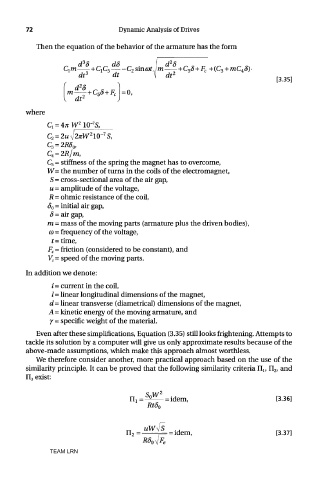
           Then the equation of the behavior of the armature has the form


        where
                       2   7
              C l = 4xW lQ- S,
                           2   7
              C 2 = 2u^2nW W~ S,
              C 3 = 2RS 0,
              C 4 = 2R/m,
              C 5 = stiffness of the spring the magnet has to overcome,
               W= the number of turns in the coils of the electromagnet,
               S = cross-sectional area of the air gap,
               u = amplitude of the voltage,
               R = ohmic resistance of the coil,
               £ 0 = initial air gap,
               8 = air gap,
               m = mass of the moving parts (armature plus the driven bodies),
               (o = frequency of the voltage,
                t=time,
               F c = friction (considered to be constant), and
               V s = speed of the moving parts.
        In addition we denote:

                i = current in the coil,
                / = linear longitudinal dimensions of the magnet,
               d = linear transverse (diametrical) dimensions of the magnet,
               A = kinetic energy of the moving armature, and
               7 - specific weight of the material.
           Even after these simplifications, Equation (3.35) still looks frightening. Attempts to
        tackle its solution by a computer will give us only approximate results because of the
        above-made assumptions, which make this approach almost worthless.
           We therefore consider another, more practical approach based on the use of the
        similarity principle. It can be proved that the following similarity criteria 1^, I1 2 , and
        n 3 exist:


               TEAM LRN

