


Page 96 - Robot Builders Source Book - Gordon McComb
P. 96
3.3 Electric Drives                         85

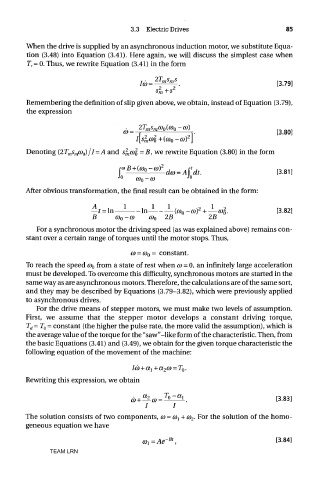
         When the drive is supplied by an asynchronous induction motor, we substitute Equa-
         tion (3.48) into Equation (3.41). Here again, we will discuss the simplest case when
         T r = 0. Thus, we rewrite Equation (3.41) in the form


         Remembering the definition of slip given above, we obtain, instead of Equation (3.79),
         the expression


         Denoting (2T ms mco^ jl=A and s^cvo =B,we rewrite Equation (3.80) in the form


        After obvious transformation, the final result can be obtained in the form:


            For a synchronous motor the driving speed (as was explained above) remains coi
         slant over a certain range of torques until the motor stops. Thus,

                                       Q) = a> 0 - constant.
         To reach the speed a> 0 from a state of rest when CD = 0, an infinitely large acceleratic
         must be developed. To overcome this difficulty, synchronous motors are started in tf
         same way as are asynchronous motors. Therefore, the calculations are of the same soi
         and they may be described by Equations (3.79-3.82), which were previously applic
         to asynchronous drives.
            For the drive means of stepper motors, we must make two levels of assumptio
        First, we assume that the stepper motor develops a constant driving torqu
         Td=T 0 = constant (the higher the pulse rate, the more valid the assumption), which
        the average value of the torque for the "saw"-like form of the characteristic. Then, fro]
        the basic Equations (3.41) and (3.49), we obtain for the given torque characteristic tr
        following equation of the movement of the machine:


        Rewriting this expression, we obtain


        The solution consists of two components, co = co l + (O 2. For the solution of the homo-
        geneous equation we have


               TEAM LRN

