


Page 174 - Robotics Designing the Mechanisms for Automated Machinery
P. 174
162               Kinematics and Control of Automatic Machines

        stiffnesses by angular stiffnesses, linear displacements by angles.) The optimum ratio
        ra/Mis 0.08-0.1.
           It must be mentioned that absorbers are less effective as vibration dampers than
        are dynamic dampers. The extinction of vibrations by dynamic means is more effec-
        tive. However, as follows from the above discussion, damping can be achieved when
        the parameters of the system are tuned accurately for all methods of damping. Unfor-
        tunately, accurate tuning is often almost impossible to achieve, for various reasons.
        For instance, the moments of inertia can change during the action of the manipula-
        tor, and the stiffnesses can also change because of changes in the effective lengths of
        the shaft when a sliding wheel moves along it. Vibration dampers that rely on friction
        are especially inaccurate. This brings us to the idea of using automatically controlled
        vibration damping. The next section is devoted to this question and describes some
        ideas on adaptive systems that can automatically tune themselves so as to minimize
        harmful vibrations. More detailed information on this subject can be found in the
        excellent book MechanicalVibrations by J. P. DenHartog (McGraw-Hill, New York, 1956).


        4.6    Automatic Vibration Damping

           We consider here some ideas for dynamic damping that can be useful for auto-
        matic vibration control under changing conditions. As a first example we discuss a
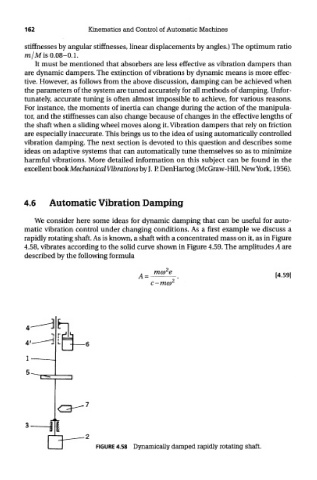
        rapidly rotating shaft. As is known, a shaft with a concentrated mass on it, as in Figure
        4.58, vibrates according to the solid curve shown in Figure 4.59. The amplitudes A are
        described by the following formula


                             FIGURE 4.58 Dynamically damped rapidly rotating shaft.

