


Page 63 - Robotics Designing the Mechanisms for Automated Machinery
P. 63
52                           Concepts and Layouts

        must lie beneath the surface so as not to interfere with the pusher 9 as it shifts the
        semi-ready link towards and through opening 8; timewise, the sixth line corresponds
        to all the movements mentioned in this connection. Lastly, the seventh line gives the
        action of wheels 10 and 11. Here there are two alternatives:
           1. The wheel rotates at constant speed. Thus, during the period Tit pulls the chain
              over the length of one link.
           2. The wheel provides interrupted motion; after the corresponding time interval
              the wheel reaches the speed V required to move one link, then rests for the
              remainder of the period (solid line in Figure 2.14). This takes up 55° of the period.
           We have denned the duration of each operation in angular units, the whole cycle
        or period obviously taking 360°. To transform the angles into time units we have to
        define the time taken up by the total period T. To design a highly productive machine
        we desire Tto decrease. On the other hand, certain restrictions limit the minimal value
        of T. These restrictions are of various kinds. One of the most important sources of
        restrictions is the kinematics and dynamics of the drives, whether purely mechanical,
        pneumatic, hydraulic, or electric. Another class of restrictions applies to purely phys-
        ical (or chemical) events. For instance, in the example above (fifth line), we mentioned
        that the operation includes the time needed for the semiready link (Figure 2.2) to fall
        through opening (8) and connect up with the previously produced links of the chain.
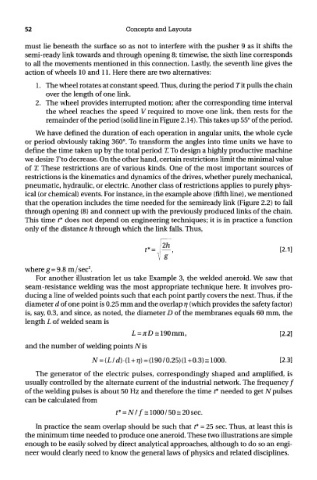
        This time t* does not depend on engineering techniques; it is in practice a function
        only of the distance h through which the link falls. Thus,


                          2
        where g= 9.8 m/sec .
           For another illustration let us take Example 3, the welded aneroid. We saw that
        seam-resistance welding was the most appropriate technique here. It involves pro-
        ducing a line of welded points such that each point partly covers the next. Thus, if the
        diameter d of one point is 0.25 mm and the overlap 77 (which provides the safety factor)
        is, say, 0.3, and since, as noted, the diameter D of the membranes equals 60 mm, the
        length L of welded seam is


           The generator of the electric pulses, correspondingly shaped and amplified, is
        usually controlled by the alternate current of the industrial network. The frequency/
        of the welding pulses is about 50 Hz and therefore the time f needed to get N pulses
        can be calculated from


           In practice the seam overlap should be such that t* = 25 sec. Thus, at least this is
        the minimum time needed to produce one aneroid. These two illustrations are simple
        enough to be easily solved by direct analytical approaches, although to do so an engi-
        neer would clearly need to know the general laws of physics and related disciplines.

