


Page 448 - Satellite Communications, Fourth Edition
P. 448
428  Chapter Fourteen


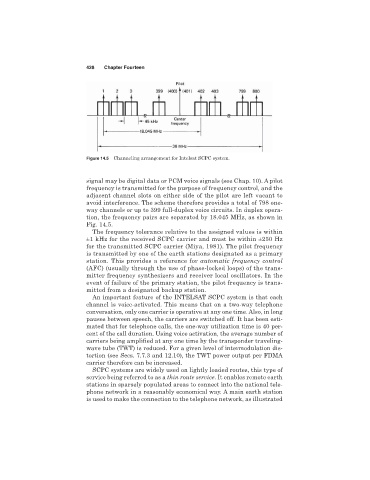
                              Figure 14.5 Channeling arrangement for Intelsat SCPC system.


                              signal may be digital data or PCM voice signals (see Chap. 10). A pilot
                              frequency is transmitted for the purpose of frequency control, and the
                              adjacent channel slots on either side of the pilot are left vacant to
                              avoid interference. The scheme therefore provides a total of 798 one-
                              way channels or up to 399 full-duplex voice circuits. In duplex opera-
                              tion, the frequency pairs are separated by 18.045 MHz, as shown in
                              Fig. 14.5.
                                The frequency tolerance relative to the assigned values is within
                              ±1 kHz for the received SCPC carrier and must be within ±250 Hz
                              for the transmitted SCPC carrier (Miya, 1981). The pilot frequency
                              is transmitted by one of the earth stations designated as a primary
                              station. This provides a reference for automatic frequency control
                              (AFC) (usually through the use of phase-locked loops) of the trans-
                              mitter frequency synthesizers and receiver local oscillators. In the
                              event of failure of the primary station, the pilot frequency is trans-
                              mitted from a designated backup station.
                                An important feature of the INTELSAT SCPC system is that each
                              channel is voice-activated. This means that on a two-way telephone
                              conversation, only one carrier is operative at any one time. Also, in long
                              pauses between speech, the carriers are switched off. It has been esti-
                              mated that for telephone calls, the one-way utilization time is 40 per-
                              cent of the call duration. Using voice activation, the average number of
                              carriers being amplified at any one time by the transponder traveling-
                              wave tube (TWT) is reduced. For a given level of intermodulation dis-
                              tortion (see Secs. 7.7.3 and 12.10), the TWT power output per FDMA
                              carrier therefore can be increased.
                                SCPC systems are widely used on lightly loaded routes, this type of
                              service being referred to as a thin route service. It enables remote earth
                              stations in sparsely populated areas to connect into the national tele-
                              phone network in a reasonably economical way. A main earth station
                              is used to make the connection to the telephone network, as illustrated

