


Page 454 - Satellite Communications, Fourth Edition
P. 454
434  Chapter Fourteen

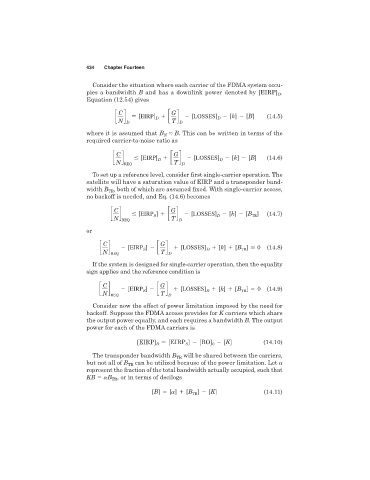
                                Consider the situation where each carrier of the FDMA system occu-
                              pies a bandwidth B and has a downlink power denoted by [EIRP] .
                                                                                             D
                              Equation (12.54) gives

                                       c  C d   [EIRP]   c  G d   [LOSSES]   [k]   [B]   (14.5)
                                                                         D
                                                    D
                                        N D               T D
                                                         ≈ B. This can be written in terms of the
                              where it is assumed that B N
                              required carrier-to-noise ratio as

                                      c  C d    [EIRP]   c  G  d   [LOSSES]   [k]   [B]  (14.6)
                                                                          D
                                                     D
                                       N REQ              T D
                                To set up a reference level, consider first single-carrier operation. The
                              satellite will have a saturation value of EIRP and a transponder band-
                              width B , both of which are assumed fixed. With single-carrier access,
                                     TR
                              no backoff is needed, and Eq. (14.6) becomes

                                      c  C d    [EIRP ]   c G d   [LOSSES]   [k]   [B ]  (14.7)
                                                                                    TR
                                                                         D
                                                    S
                                      N REQ               T D
                              or
                                  c  C d    [EIRP ]   c  G  d   [LOSSES]   [k]   [B ]   0  (14.8)
                                                S
                                                                     D
                                                                                 TR
                                   N REQ              T D
                                If the system is designed for single-carrier operation, then the equality
                              sign applies and the reference condition is

                                  c  C d    [EIRP ]   c G  d   [LOSSES]   [k]   [B ]   0  (14.9)
                                                                                 TR
                                                                     D
                                                S
                                   N REQ              T D
                                Consider now the effect of power limitation imposed by the need for
                              backoff. Suppose the FDMA access provides for K carriers which share
                              the output power equally, and each requires a bandwidth B. The output
                              power for each of the FDMA carriers is

                                                        [EIRP ]   [BO]   [K]            (14.10)
                                              [EIRP] D        S        0
                                The transponder bandwidth B TR  will be shared between the carriers,
                              but not all of B TR  can be utilized because of the power limitation. Let
                              represent the fraction of the total bandwidth actually occupied, such that
                              KB    B , or in terms of decilogs
                                      TR
                                                   [B]   [ ]   [B ]   [K]               (14.11)
                                                                 TR

