


Page 464 - Satellite Communications, Fourth Edition
P. 464
444  Chapter Fourteen

                                Interburst interference may be a problem with the tuned-circuit
                              method because of the energy stored in the tuned circuit for any given
                              burst. Avoidance of interburst interference requires careful design of the
                              tuned circuit (Miya, 1981) and possibly the use of a postamble, as men-
                              tioned in the  Sec. 14.7.2.
                                Other methods of carrier recovery are discussed in Gagliardi (1991).


                              14.7.4 Network synchronization
                              Network synchronization is required to ensure that all bursts arrive at
                              the satellite in their correct time slots. As mentioned previously, timing
                              markers are provided by the reference bursts, which are tied to a highly
                              stable clock at the reference station and transmitted through the satel-
                              lite link to the traffic stations. At any given traffic station, detection of
                              the unique word (or burst code word) in the reference burst signals the
                              start of receiving frame (SORF), the marker coinciding with the last bit
                              in the unique word.
                                It would be desirable to have the highly stable clock located aboard
                              the satellite because this would eliminate the variations in propagation
                              delay arising from the uplink for the reference station, but this is not
                              practical because of weight and space limitations. However, the refer-
                              ence bursts retransmitted from the satellite can be treated, for timing
                              purposes, as if they originated from the satellite (Spilker, 1977).
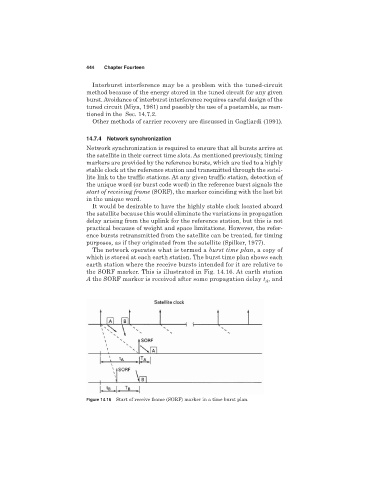
                                The network operates what is termed a burst time plan,a copy of
                              which is stored at each earth station. The burst time plan shows each
                              earth station where the receive bursts intended for it are relative to
                              the SORF marker. This is illustrated in Fig. 14.16. At earth station
                              A the SORF marker is received after some propagation delay t , and
                                                                                         A


                              Figure 14.16 Start of receive frame (SORF) marker in a time burst plan.

