


Page 144 - Schaum's Outline of Differential Equations
P. 144
CHAP.  14]            SECOND-ORDER LINEAR  DIFFERENTIAL  EQUATIONS                    127


                                                                           3
         14.24.  A solid cylinder partially submerged in water having weight density 62.5 Ib/ft , with its axis vertical, oscil-
               lates up and down within a period of 0.6 sec. Determine the diameter of the cylinder if it weighs 2 Ib.
                  With p = 62.5 Ib/ft 3  and m = 2/32 slugs, Eq. (14.10)  becomes


               which has as its general  solution


               Its  circular  frequency  is   its  natural  frequency  is               its  period  is
               T=  !//=  1/8.92r. We are given 0.6 = T=  1/8.92r, thus r = 0.187 ft = 2.24 in with a diameter  of 4.48 in.

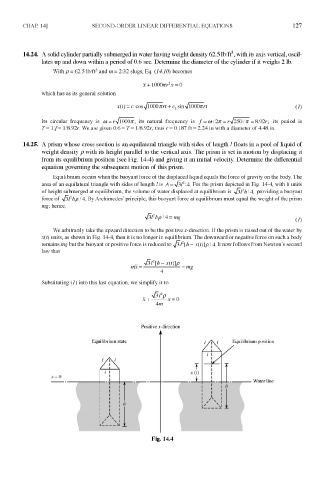
         14.25.  A prism whose cross section is an equilateral  triangle with sides of length  / floats  in a pool of liquid of
               weight density p with its height parallel  to the vertical axis. The prism is set in motion by displacing  it
               from  its equilibrium  position  (see Fig.  14-4)  and giving it an initial  velocity. Determine  the differential
               equation governing the subsequent motion  of this prism.
                  Equilibrium occurs  when the buoyant force of the displaced  liquid equals the force of gravity on the body.  The
                                                           2
               area of an equilateral  triangle with sides of length / is  A = v3/ /4. For the prism depicted  in Fig. 14-4, with h units
               of height submerged  at equilibrium, the volume of water  displaced  at equilibrium is  -J^fhl  4,  providing a buoyant
                        2
               force of  v3/ Ap / 4. By Archimedes'  principle, this buoyant force at equilibrium must equal  the weight of the prism
               mg;  hence,


                  We arbitrarily take the upward direction to be the positive x-direction. If the prism is raised  out of the water by
               x(t)  units, as shown in Fig.  14-4, then it is no longer in equilibrium. The downward  or negative force on such a body
                                                           2
               remains mg but the buoyant or positive force is reduced  to ^J3l [h  -  x(t)]p  14. It now follows from Newton's  second
               law that


               Substituting (1) into this last equation,  we  simplify  it to


                                                  Fig. 14.4

