


Page 261 - Sedimentology and Stratigraphy
P. 261
248    Deep Marine Environments


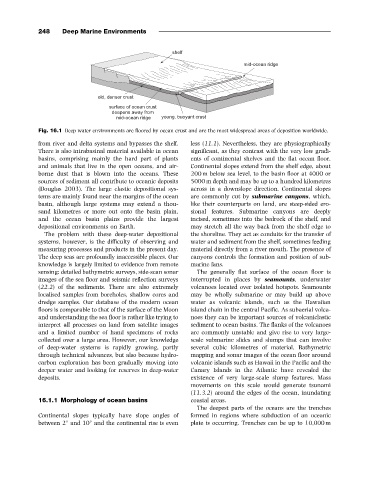
                  Fig. 16.1 Deep water environments are floored by ocean crust and are the most widespread areas of deposition worldwide.
                  from river and delta systems and bypasses the shelf.  less (11.1). Nevertheless, they are physiographically
                  There is also intrabasinal material available in ocean  significant, as they contrast with the very low gradi-
                  basins, comprising mainly the hard part of plants  ents of continental shelves and the flat ocean floor.
                  and animals that live in the open oceans, and air-  Continental slopes extend from the shelf edge, about
                  borne dust that is blown into the oceans. These  200 m below sea level, to the basin floor at 4000 or
                  sources of sediment all contribute to oceanic deposits  5000 m depth and may be up to a hundred kilometres
                  (Douglas 2003). The large clastic depositional sys-  across in a downslope direction. Continental slopes
                  tems are mainly found near the margins of the ocean  are commonly cut by submarine canyons, which,
                  basin, although large systems may extend a thou-  like their counterparts on land, are steep-sided ero-
                  sand kilometres or more out onto the basin plain,  sional features. Submarine canyons are deeply
                  and the ocean basin plains provide the largest  incised, sometimes into the bedrock of the shelf, and
                  depositional environments on Earth.         may stretch all the way back from the shelf edge to
                    The problem with these deep-water depositional  the shoreline. They act as conduits for the transfer of
                  systems, however, is the difficulty of observing and  water and sediment from the shelf, sometimes feeding
                  measuring processes and products in the present day.  material directly from a river mouth. The presence of
                  The deep seas are profoundly inaccessible places. Our  canyons controls the formation and position of sub-
                  knowledge is largely limited to evidence from remote  marine fans.
                  sensing: detailed bathymetric surveys, side-scan sonar  The generally flat surface of the ocean floor is
                  images of the sea floor and seismic reflection surveys  interrupted in places by seamounts, underwater
                  (22.2) of the sediments. There are also extremely  volcanoes located over isolated hotspots. Seamounts
                  localised samples from boreholes, shallow cores and  may be wholly submarine or may build up above
                  dredge samples. Our database of the modern ocean  water as volcanic islands, such as the Hawaiian
                  floors is comparable to that of the surface of the Moon  island chain in the central Pacific. As subaerial volca-
                  and understanding the sea floor is rather like trying to  noes they can be important sources of volcaniclastic
                  interpret all processes on land from satellite images  sediment to ocean basins. The flanks of the volcanoes
                  and a limited number of hand specimens of rocks  are commonly unstable and give rise to very large-
                  collected over a large area. However, our knowledge  scale submarine slides and slumps that can involve
                  of deep-water systems is rapidly growing, partly  several cubic kilometres of material. Bathymetric
                  through technical advances, but also because hydro-  mapping and sonar images of the ocean floor around
                  carbon exploration has been gradually moving into  volcanic islands such as Hawaii in the Pacific and the
                  deeper water and looking for reserves in deep-water  Canary Islands in the Atlantic have revealed the
                  deposits.                                   existence of very large-scale slump features. Mass
                                                              movements on this scale would generate tsunami
                                                              (11.3.2) around the edges of the ocean, inundating
                  16.1.1 Morphology of ocean basins           coastal areas.
                                                                The deepest parts of the oceans are the trenches
                  Continental slopes typically have slope angles of  formed in regions where subduction of an oceanic
                  between 28 and 108 and the continental rise is even  plate is occurring. Trenches can be up to 10,000 m

