


Page 257 - Sedimentology and Stratigraphy
P. 257
244    Shallow Marine Carbonate and Evaporite Environments


                                                                  #

                                                         #


                                !


                                 %


                                                                #

                                                         #


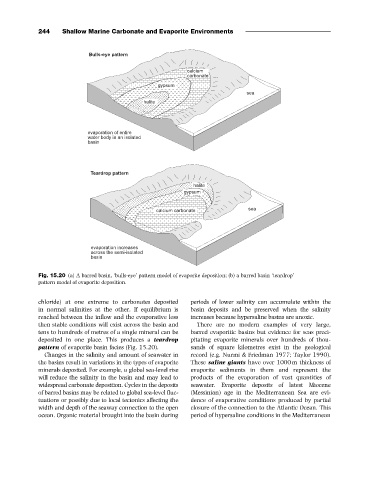
                  Fig. 15.20 (a) A barred basin, ‘bulls-eye’ pattern model of evaporite deposition; (b) a barred basin ‘teardrop’
                  pattern model of evaporite deposition.


                  chloride) at one extreme to carbonates deposited  periods of lower salinity can accumulate within the
                  in normal salinities at the other. If equilibrium is  basin deposits and be preserved when the salinity
                  reached between the inflow and the evaporative loss  increases because hypersaline basins are anoxic.
                  then stable conditions will exist across the basin and  There are no modern examples of very large,
                  tens to hundreds of metres of a single mineral can be  barred evaporitic basins but evidence for seas preci-
                  deposited in one place. This produces a teardrop  pitating evaporite minerals over hundreds of thou-
                  pattern of evaporite basin facies (Fig. 15.20).  sands of square kilometres exist in the geological
                    Changes in the salinity and amount of seawater in  record (e.g. Nurmi & Friedman 1977; Taylor 1990).
                  the basins result in variations in the types of evaporite  These saline giants have over 1000 m thickness of
                  minerals deposited. For example, a global sea-level rise  evaporite sediments in them and represent the
                  will reduce the salinity in the basin and may lead to  products of the evaporation of vast quantities of
                  widespread carbonate deposition. Cycles in the deposits  seawater. Evaporite deposits of latest Miocene
                  of barred basins may be related to global sea-level fluc-  (Messinian) age in the Mediterranean Sea are evi-
                  tuations or possibly due to local tectonics affecting the  dence of evaporative conditions produced by partial
                  width and depth of the seaway connection to the open  closure of the connection to the Atlantic Ocean. This
                  ocean. Organic material brought into the basin during  period of hypersaline conditions in the Mediterranean

