


Page 252 - Sedimentology and Stratigraphy
P. 252
Types of Carbonate Platform  239


                 hummocky and swaley cross-stratification (14.2.1). In
                 deeper water below storm wave base the outer ramp
                 deposits are principally redeposited carbonate mud-
                 stone and wackestone, often with the characteristics
                 of turbidites. Redeposition of carbonate sediments is
                 common in situations where the outer edge of the
                 ramp merges into a steeper slope at a continental
                 margin as a distally steepened ramp. Homoclinal
                 ramps have a consistent gentle slope on which little
                 reworking of material by mass-flow processes occurs
                 (Read 1985). In contrast to rimmed shelves reefal
                 build-ups are relatively rare in ramp settings. Isolated
                 patch reefs may occur in the more proximal parts of a
                 ramp and mud mounds are known from Palaeozoic
                 ramp environments.

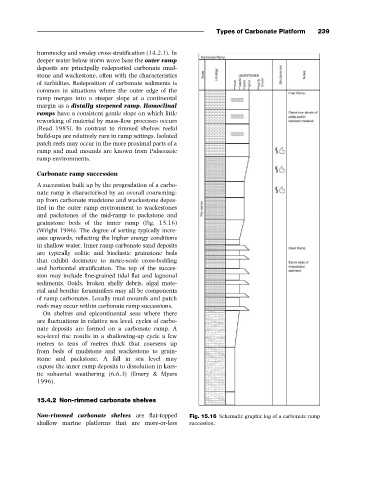
                 Carbonate ramp succession
                 A succession built up by the progradation of a carbo-
                 nate ramp is characterised by an overall coarsening-
                 up from carbonate mudstone and wackestone depos-
                 ited in the outer ramp environment to wackestones
                 and packstones of the mid-ramp to packstone and
                 grainstone beds of the inner ramp (Fig. 15.16)
                 (Wright 1986). The degree of sorting typically incre-
                 ases upwards, reflecting the higher energy conditions
                 in shallow water. Inner ramp carbonate sand deposits
                 are typically oolitic and bioclastic grainstone beds
                 that exhibit decimetre to metre-scale cross-bedding
                 and horizontal stratification. The top of the succes-
                 sion may include fine-grained tidal flat and lagoonal
                 sediments. Ooids, broken shelly debris, algal mate-
                 rial and benthic foraminifers may all be components
                 of ramp carbonates. Locally mud mounds and patch
                 reefs may occur within carbonate ramp successions.
                   On shelves and epicontinental seas where there
                 are fluctuations in relative sea level, cycles of carbo-
                 nate deposits are formed on a carbonate ramp. A
                 sea-level rise results in a shallowing-up cycle a few
                 metres to tens of metres thick that coarsens up
                 from beds of mudstone and wackestone to grain-
                 stone and packstone. A fall in sea level may
                 expose the inner ramp deposits to dissolution in kars-
                 tic subaerial weathering (6.6.3) (Emery & Myers
                 1996).

                 15.4.2 Non-rimmed carbonate shelves

                 Non-rimmed carbonate shelves are flat-topped  Fig. 15.16 Schematic graphic log of a carbonate ramp
                 shallow marine platforms that are more-or-less  succession.

