


Page 247 - Sedimentology and Stratigraphy
P. 247
234    Shallow Marine Carbonate and Evaporite Environments


     	 	 	        		    unusual reef-forming organism was a type of bivalve,
                   &                          ,               the rudists: the shells of these molluscs were thick
                                                              and conical, forming massive colonies, which are
                           #            -#             ,       ,  characteristic of many Cretaceous reefs (Ross & Skel-
                                                              ton 1993). Not only has the type of organism forming
                   '#                         ,        ,                  reefs varied through time, but also the relative impor-
                   (                          ,                  tance of reefs as depositional systems has changed,
                                        .    ,        ,         with four peaks of dominance in the Phanerozoic
                                                              (Fig. 15.10) separated by times when mud mounds
                              #
                                                              were the more common bioherms.
                   )                          ,
                   *  #
                                                              Reef structures
                   +                          ,        ,
                                                              Modern reefs can be divided into a number of distinct
                                                              subenvironments (Fig. 15.12). The reef crest is the site
                                                              of growth of the corals that build the most robust struc-
                                        *
                                                              tures, encrusting and massive forms capable of with-
                                                              standing the force of waves in very shallow water.
                  Fig. 15.10 The type and abundance of carbonate reefs has  Going down the reef front these massive and encrusting
                  varied through the Phanerozoic (data from Tucker, 1992).  forms of coral are replaced by branching and more
                                                              delicate plate-like forms in the lower energy, deeper
                                                              water. Behind the reef crest is a reef flat, also comprising
                  that is, they have a symbiotic relationship with algae,  relatively robust forms, but conditions become quieter
                  which allows the corals to grow rapidly in relatively  close to the back-reef area and globular coral forms are
                  nutrient-poor water. The other main modern reefs  common in this region (Tucker & Wright 1990; Wright
                  builders are calcareous algae. However, over the  & Burchette 1996).
                  past 2500 Myr a number of different types of organ-  In addition to the main reef builders that form
                  isms have performed this role (Tucker 1992). The  the framework, other organisms play an impor-
                  earliest reef-builders were cyanobacteria, which cre-  tant role too: encrusting organisms such as bryo-
                  ated stromatolites, followed in the Palaeozoic by  zoa and calcareous algae also help to stabilise the
                  rugose and tabulate corals and calcareous sponges  framework and the remains of a wide variety of
                  (including stromatoporoids, which were particularly  organisms that live within the reef provide additional
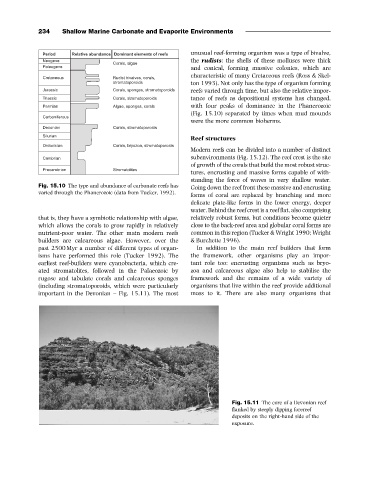
                  important in the Devonian – Fig. 15.11). The most  mass to it. There are also many organisms that


                                                                          Fig. 15.11 The core of a Devonian reef
                                                                          flanked by steeply dipping forereef
                                                                          deposits on the right-hand side of the
                                                                          exposure.

