


Page 242 - Sedimentology and Stratigraphy
P. 242
Coastal Carbonate and Evaporite Environments  229


                                                             !


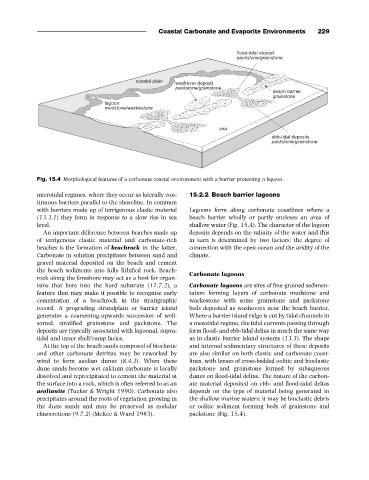
                 Fig. 15.4 Morphological features of a carbonate coastal environment with a barrier protecting a lagoon.

                 microtidal regimes, where they occur as laterally con-  15.2.2 Beach barrier lagoons
                 tinuous barriers parallel to the shoreline. In common
                 with barriers made up of terrigenous clastic material  Lagoons form along carbonate coastlines where a
                 (13.3.1) they form in response to a slow rise in sea  beach barrier wholly or partly encloses an area of
                 level.                                       shallow water (Fig. 15.4). The character of the lagoon
                   An important difference between beaches made up  deposits depends on the salinity of the water and this
                 of terrigenous clastic material and carbonate-rich  in turn is determined by two factors: the degree of
                 beaches is the formation of beachrock in the latter.  connection with the open ocean and the aridity of the
                 Carbonate in solution precipitates between sand and  climate.
                 gravel material deposited on the beach and cement
                 the beach sediments into fully lithified rock. Beach-  Carbonate lagoons
                 rock along the foreshore may act as a host for organ-
                 isms that bore into the hard substrate (11.7.2), a  Carbonate lagoons are sites of fine-grained sedimen-
                 feature that may make it possible to recognise early  tation forming layers of carbonate mudstone and
                 cementation of a beachrock in the stratigraphic  wackestone with some grainstone and packstone
                 record. A prograding strandplain or barrier island  beds deposited as washovers near the beach barrier.
                 generates a coarsening-upwards succession of well-  Where a barrier island ridge is cut by tidal channels in
                 sorted, stratified grainstone and packstone. The  a mesotidal regime, the tidal currents passing through
                 deposits are typically associated with lagoonal, supra-  form flood- and ebb-tidal deltas in much the same way
                 tidal and inner shelf/ramp facies.           as in clastic barrier island systems (13.3). The shape
                   At the top of the beach sands composed of bioclastic  and internal sedimentary structures of these deposits
                 and other carbonate detritus may be reworked by  are also similar on both clastic and carbonate coast-
                 wind to form aeolian dunes (8.4.2). When these  lines, with lenses of cross-bedded oolitic and bioclastic
                 dune sands become wet calcium carbonate is locally  packstone and grainstone formed by subaqueous
                 dissolved and reprecipitated to cement the material at  dunes on flood-tidal deltas. The nature of the carbon-
                 the surface into a rock, which is often referred to as an  ate material deposited on ebb- and flood-tidal deltas
                 aeolianite (Tucker & Wright 1990). Carbonate also  depends on the type of material being generated in
                 precipitates around the roots of vegetation growing in  the shallow marine waters: it may be bioclastic debris
                 the dune sands and may be preserved as nodular  or oolitic sediment forming beds of grainstone and
                 rhizocretions (9.7.2) (McKee & Ward 1983).   packstone (Fig. 15.4).

