


Page 243 - Sedimentology and Stratigraphy
P. 243
230    Shallow Marine Carbonate and Evaporite Environments


                                                                                   !


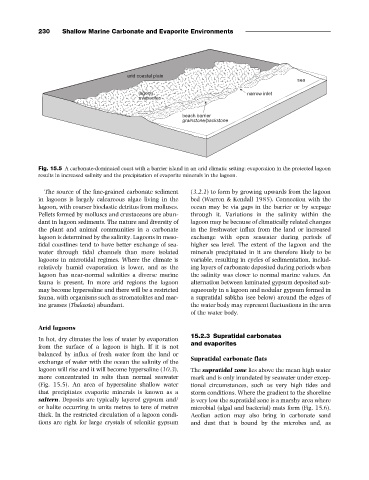
                  Fig. 15.5 A carbonate-dominated coast with a barrier island in an arid climatic setting: evaporation in the protected lagoon
                  results in increased salinity and the precipitation of evaporite minerals in the lagoon.

                    The source of the fine-grained carbonate sediment  (3.2.1) to form by growing upwards from the lagoon
                  in lagoons is largely calcareous algae living in the  bed (Warren & Kendall 1985). Connection with the
                  lagoon, with coarser bioclastic detritus from molluscs.  ocean may be via gaps in the barrier or by seepage
                  Pellets formed by molluscs and crustaceans are abun-  through it. Variations in the salinity within the
                  dant in lagoon sediments. The nature and diversity of  lagoon may be because of climatically related changes
                  the plant and animal communities in a carbonate  in the freshwater influx from the land or increased
                  lagoon is determined by the salinity. Lagoons in meso-  exchange with open seawater during periods of
                  tidal coastlines tend to have better exchange of sea-  higher sea level. The extent of the lagoon and the
                  water through tidal channels than more isolated  minerals precipitated in it are therefore likely to be
                  lagoons in microtidal regimes. Where the climate is  variable, resulting in cycles of sedimentation, includ-
                  relatively humid evaporation is lower, and as the  ing layers of carbonate deposited during periods when
                  lagoon has near-normal salinities a diverse marine  the salinity was closer to normal marine values. An
                  fauna is present. In more arid regions the lagoon  alternation between laminated gypsum deposited sub-
                  may become hypersaline and there will be a restricted  aqueously in a lagoon and nodular gypsum formed in
                  fauna, with organisms such as stromatolites and mar-  a supratidal sabkha (see below) around the edges of
                  ine grasses (Thalassia) abundant.           the water body may represent fluctuations in the area
                                                              of the water body.

                  Arid lagoons
                                                              15.2.3 Supratidal carbonates
                  In hot, dry climates the loss of water by evaporation
                  from the surface of a lagoon is high. If it is not  and evaporites
                  balanced by influx of fresh water from the land or
                                                              Supratidal carbonate flats
                  exchange of water with the ocean the salinity of the
                  lagoon will rise and it will become hypersaline (10.3),  The supratidal zone lies above the mean high water
                  more concentrated in salts than normal seawater  mark and is only inundated by seawater under excep-
                  (Fig. 15.5). An area of hypersaline shallow water  tional circumstances, such as very high tides and
                  that precipitates evaporite minerals is known as a  storm conditions. Where the gradient to the shoreline
                  saltern. Deposits are typically layered gypsum and/  is very low the supratidal zone is a marshy area where
                  or halite occurring in units metres to tens of metres  microbial (algal and bacterial) mats form (Fig. 15.6).
                  thick. In the restricted circulation of a lagoon condi-  Aeolian action may also bring in carbonate sand
                  tions are right for large crystals of selenitic gypsum  and dust that is bound by the microbes and, as

