


Page 239 - Sedimentology and Stratigraphy
P. 239
226    Shallow Marine Carbonate and Evaporite Environments


                  environment, principally in places where reef forma-  regions the rainfall, and hence the run-off, is very
                  tion strongly controls the distribution of energy  low, which means that there is little transport of
                  regimes. Finally, the production of carbonate material  sediment to the sea by rivers.
                  by organisms is rapid in geological terms, and occurs
                  at rates that can commonly keep pace with changes
                                                              Shallow marine waters
                  in water depth due to tectonic subsidence or eustatic
                  sea-level rises: this has important consequences for  Biogenic carbonate production is inhibited by the
                  the formation of depositional sequences (Chapter 23).  presence of clastic material so the areas of low input
                                                              of detritus are potential sites for carbonate deposition.
                                                              Under favourable conditions, the amount of biogenic
                  15.1.1 Controls on carbonate sedimentation  carbonate produced in shallow seas is determined by
                                                              the productivity within the food chain. Photosyn-
                  Areas of shallow marine carbonate sedimentation are  thetic plants and algae at the bottom of the food
                  known as carbonate platforms. They can occur in a  chain are dependent on the availability of light, and
                  wide variety of climatic and tectonic settings provided  penetration by sunlight is controlled by the water
                  that two main conditions are met: (a) isolation from  depth and the amount of suspended material in the
                  clastic supply and (b) shallow marine waters. The  sea. Relatively shallow waters with low amounts of
                  types of carbonate grains deposited and the facies  suspended terrigenous clastic material are therefore
                  they form are mainly controlled by climatic condi-  most favourable and in bright tropical regions with
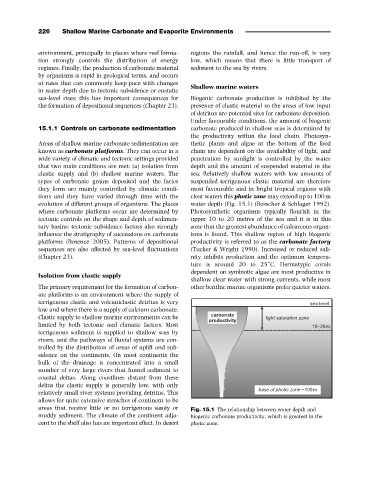
                  tions and they have varied through time with the  clear waters this photic zone may extend up to 100 m
                  evolution of different groups of organisms. The places  water depth (Fig. 15.1) (Bosscher & Schlager 1992).
                  where carbonate platforms occur are determined by  Photosynthetic organisms typically flourish in the
                  tectonic controls on the shape and depth of sedimen-  upper 10 to 20 metres of the sea and it is in this
                  tary basins: tectonic subsidence factors also strongly  zone that the greatest abundance of calcareous organ-
                  influence the stratigraphy of successions on carbonate  isms is found. This shallow region of high biogenic
                  platforms (Bosence 2005). Patterns of depositional  productivity is referred to as the carbonate factory
                  sequences are also affected by sea-level fluctuations  (Tucker & Wright 1990). Increased or reduced sali-
                  (Chapter 23).                               nity inhibits production and the optimum tempera-
                                                              ture is around 20 to 25˚ C. Hermatypic corals
                                                              dependent on symbiotic algae are most productive in
                  Isolation from clastic supply
                                                              shallow clear water with strong currents, while most
                  The primary requirement for the formation of carbon-  other benthic marine organisms prefer quieter waters.
                  ate platforms is an environment where the supply of
                  terrigenous clastic and volcaniclastic detritus is very
                  low and where there is a supply of calcium carbonate.

                  Clastic supply to shallow marine environments can be
                  limited by both tectonic and climatic factors. Most
                  terrigenous sediment is supplied to shallow seas by
                  rivers, and the pathways of fluvial systems are con-
                  trolled by the distribution of areas of uplift and sub-
                  sidence on the continents. On most continents the
                  bulk of the drainage is concentrated into a small
                  number of very large rivers that funnel sediment to
                  coastal deltas. Along coastlines distant from these
                  deltas the clastic supply is generally low, with only

                  relatively small river systems providing detritus. This
                  allows for quite extensive stretches of continent to be
                  areas that receive little or no terrigenous sandy or  Fig. 15.1 The relationship between water depth and
                  muddy sediment. The climate of the continent adja-  biogenic carbonate productivity, which is greatest in the
                  cent to the shelf also has an important effect. In desert  photic zone.

