


Page 241 - Sedimentology and Stratigraphy
P. 241
228    Shallow Marine Carbonate and Evaporite Environments


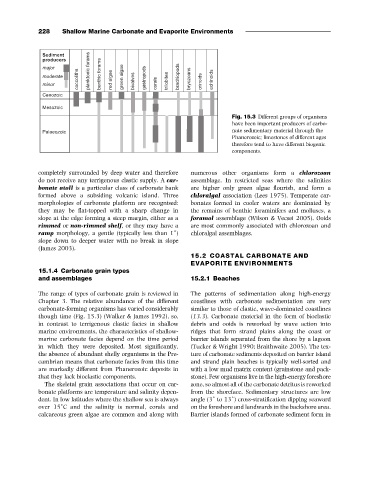
                                                                          Fig. 15.3 Different groups of organisms
                                                                          have been important producers of carbo-
                                                                          nate sedimentary material through the
                                                                          Phanerozoic; limestones of different ages
                                                                          therefore tend to have different biogenic
                                                                          components.

                  completely surrounded by deep water and therefore  numerous other organisms form a chlorozoan
                  do not receive any terrigenous clastic supply. A car-  assemblage. In restricted seas where the salinities
                  bonate atoll is a particular class of carbonate bank  are higher only green algae flourish, and form a
                  formed above a subsiding volcanic island. Three  chloralgal association (Lees 1975). Temperate car-
                  morphologies of carbonate platform are recognised:  bonates formed in cooler waters are dominated by
                  they may be flat-topped with a sharp change in  the remains of benthic foraminifers and molluscs, a
                  slope at the edge forming a steep margin, either as a  foramol assemblage (Wilson & Vecsei 2005). Ooids
                  rimmed or non-rimmed shelf, or they may have a  are most commonly associated with chlorozoan and
                  ramp morphology, a gentle (typically less than 1˚ )  chloralgal assemblages.
                  slope down to deeper water with no break in slope
                  (James 2003).
                                                              15.2 COASTAL CARBONATE AND
                                                              EVAPORITE ENVIRONMENTS
                  15.1.4 Carbonate grain types
                  and assemblages                             15.2.1 Beaches

                  The range of types of carbonate grain is reviewed in  The patterns of sedimentation along high-energy
                  Chapter 3. The relative abundance of the different  coastlines with carbonate sedimentation are very
                  carbonate-forming organisms has varied considerably  similar to those of clastic, wave-dominated coastlines
                  though time (Fig. 15.3) (Walker & James 1992), so,  (13.3). Carbonate material in the form of bioclastic
                  in contrast to terrigenous clastic facies in shallow  debris and ooids is reworked by wave action into
                  marine environments, the characteristics of shallow-  ridges that form strand plains along the coast or
                  marine carbonate facies depend on the time period  barrier islands separated from the shore by a lagoon
                  in which they were deposited. Most significantly,  (Tucker & Wright 1990; Braithwaite 2005). The tex-
                  the absence of abundant shelly organisms in the Pre-  ture of carbonate sediments deposited on barrier island
                  cambrian means that carbonate facies from this time  and strand plain beaches is typically well-sorted and
                  are markedly different from Phanerozoic deposits in  with a low mud matrix content (grainstone and pack-
                  that they lack bioclastic components.       stone). Few organisms live in the high-energy foreshore
                    The skeletal grain associations that occur on car-  zone, so almost all of the carbonate detritus is reworked
                  bonate platforms are temperature and salinity depen-  from the shoreface. Sedimentary structures are low
                  dent. In low latitudes where the shallow sea is always  angle (3˚ to 13˚ ) cross-stratification dipping seaward
                  over 15˚ C and the salinity is normal, corals and  on the foreshore and landwards in the backshore area.
                  calcareous green algae are common and along with  Barrier islands formed of carbonate sediment form in

