


Page 236 - Sedimentology and Stratigraphy
P. 236
Criteria for the Recognition of Sandy Shallow-marine Sediments  223


                       Tidal shelf                            causes of sea-level changes and the responses to them
                                                              recorded in sedimentary successions deposited on
                        Scale  Lithology  MUD  SAND GRAVEL  Structures etc  Notes  shelves are further discussed in Chapter 23.
                               clay  silt  vf m vc  gran  pebb  cobb  boul  Sand bodies formed as sand ridges may preserve the
                                  c
                                 f
                                                              overall dimensions of the ridge if a relative sea-level
                                                              rise occurs, leaving the sands in deeper water and
                                            Foreshore: stratified
                                            sands             therefore inactive. Mud deposited over the surface of
                                                              the ridges will wholly enclose them, preserving them
                                                              as large, elongate lenses of sandstone. These bodies
                                            Shoreface: cross-
                                            bedded sands of
                                            tidal sand bars   make attractive oil and gas exploration targets
                                                              (18.7.4) because they are made up of relatively well-
                                                              sorted sandstone (a suitable reservoir rock) sur-
                                                              rounded by mudstone (a suitable reservoir seal).
                                                               One particular response to sea-level change on
                                                              sandy shelves is the deposition of a thin layer of gravel
                                            Sands reworked by  during sea-level rise. These transgressive lags form
                                            tidal currents, waves
                        10s metres          and storms        as coarse sediment deposited on the shelf during peri-
                                                              ods of low sea level is reworked by wave action: as the
                                                              sea level rises (Plint 1988; Hart & Plint 1995),
                                                              the gravel is moved by waves in a landward direction,
                                                              resulting in a thin (usually only a few tens of centi-
                                                              metres) conglomerate bed within the succession. The
                                                              clasts in the bed are likely to be well sorted and well
                                                              rounded, and hence resemble pebbly beach deposits
                                                              (13.2): the context will, however, be different, as
                                            Offshore transition:
                                            hummocky cross-   transgressive lag deposits will be associated with
                                            stratified (HCS)
                                            sands interbedded  deeper water facies of the shoreface in contrast to
                                            with bioturbated mud
                                                              the foreshore associations of a beach deposit.
                                                              14.5 CRITERIA FOR THE RECOGNITION
                                                              OF SANDY SHALLOW-MARINE
                                                              SEDIMENTS

                                                              The environments of deposition on continental
                                                              shelves vary according to water depth, sediment sup-
                                                              ply, climate and the relative importance of wave, tide
                                                              and storm processes. The products of these interacting
                                                              processes are extremely variable in terms of facies
                                                              character, sediment body geometry and stratigraphic
                                                              succession. There are, however, certain features that
                                                              can be considered to be reliable indicators of shallow
                                            Offshore:         marine environments. First, the physical processes are
                                            bioturbated mud
                                                              generally distinctive: for example, extensive sheets
                                                              and ridges of cross-bedded sand deposited by strong
                                                              currents are easily recognised and cannot be the depos-
                                                              its of any other environment, especially if there is
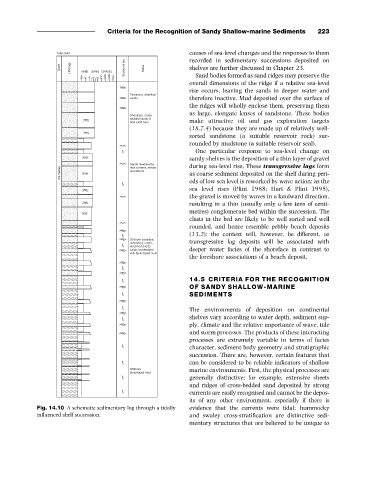
                 Fig. 14.10 A schematic sedimentary log through a tidally  evidence that the currents were tidal; hummocky
                 influenced shelf succession.                 and swaley cross-stratification are distinctive sedi-
                                                              mentary structures that are believed to be unique to

