


Page 231 - Sedimentology and Stratigraphy
P. 231
218    Shallow Sandy Seas


                  high, a few kilometres wide and tens of kilometres in
                  length, occurring spaced about 10 km apart. The sedi-

                  ments are typically well-sorted sands with a basal lag
                  of gravel (Hart & Plint 1995).

                  Offshore transition zone
                  In the offshore transition zone, between the fair-
                  weather and storm wave bases on storm-dominated
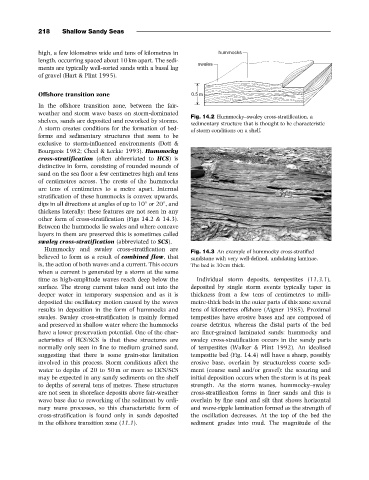
                                                              Fig. 14.2 Hummocky–swaley cross-stratification, a
                  shelves, sands are deposited and reworked by storms.
                                                              sedimentary structure that is thought to be characteristic
                  A storm creates conditions for the formation of bed-  of storm conditions on a shelf.
                  forms and sedimentary structures that seem to be
                  exclusive to storm-influenced environments (Dott &
                  Bourgeois 1982; Cheel & Leckie 1993). Hummocky
                  cross-stratification (often abbreviated to HCS)is
                  distinctive in form, consisting of rounded mounds of
                  sand on the sea floor a few centimetres high and tens
                  of centimetres across. The crests of the hummocks
                  are tens of centimetres to a metre apart. Internal
                  stratification of these hummocks is convex upwards,
                  dips in all directions at angles of up to 108 or 208, and
                  thickens laterally: these features are not seen in any
                  other form of cross-stratification (Figs 14.2 & 14.3).
                  Between the hummocks lie swales and where concave
                  layers in them are preserved this is sometimes called
                  swaley cross-stratification (abbreviated to SCS).
                    Hummocky and swaley cross-stratification are
                                                              Fig. 14.3 An example of hummocky cross-stratified
                  believed to form as a result of combined flow, that  sandstone with very well-defined, undulating laminae.
                  is, the action of both waves and a current. This occurs  The bed is 30 cm thick.
                  when a current is generated by a storm at the same
                  time as high-amplitude waves reach deep below the  Individual storm deposits, tempestites (11.3.1),
                  surface. The strong current takes sand out into the  deposited by single storm events typically taper in
                  deeper water in temporary suspension and as it is  thickness from a few tens of centimetres to milli-
                  deposited the oscillatory motion caused by the waves  metre-thick beds in the outer parts of this zone several
                  results in deposition in the form of hummocks and  tens of kilometres offshore (Aigner 1985). Proximal
                  swales. Swaley cross-stratification is mainly formed  tempestites have erosive bases and are composed of
                  and preserved in shallow water where the hummocks  coarse detritus, whereas the distal parts of the bed
                  have a lower preservation potential. One of the char-  are finer-grained laminated sands: hummocky and
                  acteristics of HCS/SCS is that these structures are  swaley cross-stratification occurs in the sandy parts
                  normally only seen in fine to medium grained sand,  of tempestites (Walker & Plint 1992). An idealised
                  suggesting that there is some grain-size limitation  tempestite bed (Fig. 14.4) will have a sharp, possibly
                  involved in this process. Storm conditions affect the  erosive base, overlain by structureless coarse sedi-
                  water to depths of 20 to 50 m or more so HCS/SCS  ment (coarse sand and/or gravel): the scouring and
                  may be expected in any sandy sediments on the shelf  initial deposition occurs when the storm is at its peak
                  to depths of several tens of metres. These structures  strength. As the storm wanes, hummocky–swaley
                  are not seen in shoreface deposits above fair-weather  cross-stratification forms in finer sands and this is
                  wave base due to reworking of the sediment by ordi-  overlain by fine sand and silt that shows horizontal
                  nary wave processes, so this characteristic form of  and wave-ripple lamination formed as the strength of
                  cross-stratification is found only in sands deposited  the oscillation decreases. At the top of the bed the
                  in the offshore transition zone (11.1).     sediment grades into mud. The magnitude of the

