


Page 230 - Sedimentology and Stratigraphy
P. 230
Storm-dominated Shallow Clastic Seas  217


                 14.1.3 Shallow marine clastic environments   structures. Not all sandy deposits occurring on mod-
                                                              ern shelves have been formed by processes occurring
                 The patterns and characteristics of deposition on  in the present day: the sea-level rise in the past 10 kyr,
                 shelves and epicontinental seas with abundant terrige-  the Holocene transgression, has drowned former
                 nous clastic supply are controlled by the relative impor-  strand plain and barrier island ridges, along with
                 tance of wave, storm and tidal processes. The largest  sands deposited in the shoreface, leaving them as
                 tidal ranges tend to be in epicontinental seas and  inactive relics in deeper water.
                 restricted parts of shelves, although in some situations
                 the tidal ranges in narrow or restricted seaways
                 can be very small (11.2.2). Open shelf areas facing  14.2 STORM-DOMINATED SHALLOW
                 oceans are typically regions with a microtidal to  CLASTIC SEAS
                 mesotidal regime and are affected by ocean storms.
                 Two main types, storm-dominated shelves and  14.2.1 Facies distribution across
                 tide-dominated shelves, can be recognised in both  a storm-dominated shelf
                 modern environments and ancient facies: these are
                 end-members of a continuum and many modern   Shoreface
                 and ancient shelves and epicontinental seas show
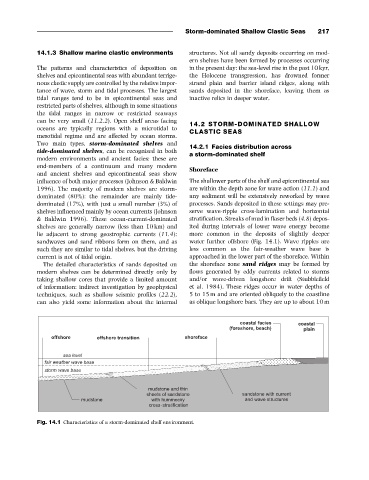
                 influence of both major processes (Johnson & Baldwin  The shallower parts of the shelf and epicontinental sea
                 1996). The majority of modern shelves are storm-  are within the depth zone for wave action (11.1) and
                 dominated (80%): the remainder are mainly tide-  any sediment will be extensively reworked by wave
                 dominated (17%), with just a small number (3%) of  processes. Sands deposited in these settings may pre-
                 shelves influenced mainly by ocean currents (Johnson  serve wave-ripple cross-lamination and horizontal
                 & Baldwin 1996). These ocean-current-dominated  stratification. Streaks of mud in flaser beds (4.8) depos-
                 shelves are generally narrow (less than 10 km) and  ited during intervals of lower wave energy become
                 lie adjacent to strong geostrophic currents (11.4):  more common in the deposits of slightly deeper
                 sandwaves and sand ribbons form on them, and as  water further offshore (Fig. 14.1). Wave ripples are
                 such they are similar to tidal shelves, but the driving  less common as the fair-weather wave base is
                 current is not of tidal origin.              approached in the lower part of the shoreface. Within
                   The detailed characteristics of sands deposited on  the shoreface zone sand ridges may be formed by
                 modern shelves can be determined directly only by  flows generated by eddy currents related to storms
                 taking shallow cores that provide a limited amount  and/or wave-driven longshore drift (Stubblefield
                 of information: indirect investigation by geophysical  et al. 1984). These ridges occur in water depths of
                 techniques, such as shallow seismic profiles (22.2),  5 to 15 m and are oriented obliquely to the coastline
                 can also yield some information about the internal  as oblique longshore bars. They are up to about 10 m


                 Fig. 14.1 Characteristics of a storm-dominated shelf environment.

