


Page 235 - Sedimentology and Stratigraphy
P. 235
222    Shallow Sandy Seas


                                                              14.3.2 Characteristics of tide-dominated
                                                              shallow-marine successions

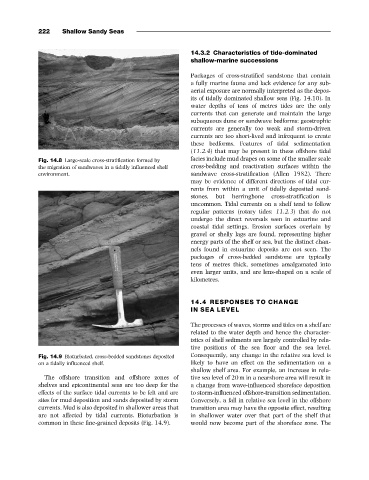
                                                              Packages of cross-stratified sandstone that contain
                                                              a fully marine fauna and lack evidence for any sub-
                                                              aerial exposure are normally interpreted as the depos-
                                                              its of tidally dominated shallow seas (Fig. 14.10). In
                                                              water depths of tens of metres tides are the only
                                                              currents that can generate and maintain the large
                                                              subaqueous dune or sandwave bedforms: geostrophic
                                                              currents are generally too weak and storm-driven
                                                              currents are too short-lived and infrequent to create
                                                              these bedforms. Features of tidal sedimentation
                                                              (11.2.4) that may be present in these offshore tidal
                  Fig. 14.8 Large-scale cross-stratification formed by  facies include mud drapes on some of the smaller scale
                  the migration of sandwaves in a tidally influenced shelf  cross-bedding and reactivation surfaces within the
                  environment.                                sandwave cross-stratification (Allen 1982). There
                                                              may be evidence of different directions of tidal cur-
                                                              rents from within a unit of tidally deposited sand-
                                                              stones,  but  herringbone  cross-stratification  is
                                                              uncommon. Tidal currents on a shelf tend to follow
                                                              regular patterns (rotary tides: 11.2.3) that do not
                                                              undergo the direct reversals seen in estuarine and
                                                              coastal tidal settings. Erosion surfaces overlain by
                                                              gravel or shelly lags are found, representing higher
                                                              energy parts of the shelf or sea, but the distinct chan-
                                                              nels found in estuarine deposits are not seen. The
                                                              packages of cross-bedded sandstone are typically
                                                              tens of metres thick, sometimes amalgamated into
                                                              even larger units, and are lens-shaped on a scale of
                                                              kilometres.


                                                              14.4 RESPONSES TO CHANGE
                                                              IN SEA LEVEL

                                                              The processes of waves, storms and tides on a shelf are
                                                              related to the water depth and hence the character-
                                                              istics of shelf sediments are largely controlled by rela-
                                                              tive positions of the sea floor and the sea level.
                  Fig. 14.9 Bioturbated, cross-bedded sandstones deposited  Consequently, any change in the relative sea level is
                  on a tidally influenced shelf.              likely to have an effect on the sedimentation on a
                                                              shallow shelf area. For example, an increase in rela-
                    The offshore transition and offshore zones of  tive sea level of 20 m in a nearshore area will result in
                  shelves and epicontinental seas are too deep for the  a change from wave-influenced shoreface deposition
                  effects of the surface tidal currents to be felt and are  to storm-influenced offshore-transition sedimentation.
                  sites for mud deposition and sands deposited by storm  Conversely, a fall in relative sea level in the offshore
                  currents. Mud is also deposited in shallower areas that  transition area may have the opposite effect, resulting
                  are not affected by tidal currents. Bioturbation is  in shallower water over that part of the shelf that
                  common in these fine-grained deposits (Fig. 14.9).  would now become part of the shoreface zone. The

