


Page 225 - Sedimentology and Stratigraphy
P. 225
212    Clastic Coasts and Estuaries


                                                              indicators. Muddy tidal flat deposits rich in organic
                                                              material may contain sandy sediment deposited within
                                                              tidal creeks, at the highest tides and during storms.


                                                              13.6.3 Recognition of estuarine
                                                              deposits: summary

                                                              There are many features in common between the
                                                              deposits of deltas and estuaries in the stratigraphic
                                                              record. Both are sedimentary bodies formed at the
                                                              interface between marine and continental environ-
                                                              ments and consequently display evidence of physical,
                                                              chemical and biological processes that are active in
                                                              both settings (e.g. an association of beds containing a
                                                              marine shelly fauna with other units containing root-
                                                              lets). The key difference is that a delta is a prograda-
                                                              tional sediment body, that is, it builds out into the sea
                                                              and will show a coarsening-up succession produced by
                                                              this progradation. In contrast, estuaries are mainly
                                                              aggradational, building up within a drowned river
                                                              channel. The base of an estuarine succession is there-
                                                              fore commonly an erosion surface scoured at the
                                                              mouth of the river, for example, in response to sea-
                                                              level fall. It may be difficult to distinguish between the
                                                              deposits of a tidal estuary and a tide-dominated delta if
                                                              there is limited information and it is difficult to estab-
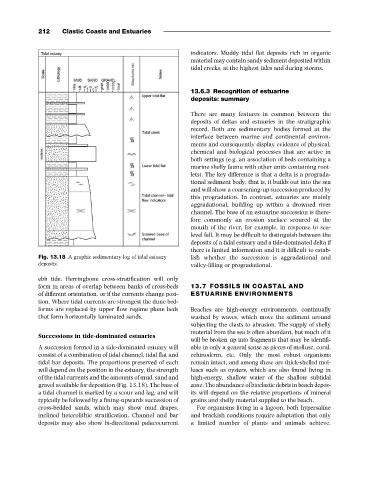
                  Fig. 13.18 A graphic sedimentary log of tidal estuary  lish whether the succession is aggradational and
                  deposits.                                   valley-filling or progradational.

                  ebb tide. Herringbone cross-stratification will only
                  form in areas of overlap between banks of cross-beds  13.7 FOSSILS IN COASTAL AND
                  of different orientation, or if the currents change posi-  ESTUARINE ENVIRONMENTS
                  tion. Where tidal currents are strongest the dune bed-
                  forms are replaced by upper flow regime plane beds  Beaches are high-energy environments, continually
                  that form horizontally laminated sands.     washed by waves, which move the sediment around
                                                              subjecting the clasts to abrasion. The supply of shelly
                                                              material from the sea is often abundant, but much of it
                  Successions in tide-dominated estuaries
                                                              will be broken up into fragments that may be identifi-
                  A succession formed in a tide-dominated estuary will  able in only a general sense as pieces of mollusc, coral,
                  consist of a combination of tidal channel, tidal flat and  echinoderm, etc. Only the most robust organisms
                  tidal bar deposits. The proportions preserved of each  remain intact, and among these are thick-shelled mol-
                  will depend on the position in the estuary, the strength  luscs such as oysters, which are also found living in
                  of the tidal currents and the amounts of mud, sand and  high-energy, shallow water of the shallow subtidal
                  gravel available for deposition (Fig. 13.18). The base of  zone. The abundance of bioclastic debris in beach depos-
                  a tidal channel is marked by a scour and lag, and will  its will depend on the relative proportions of mineral
                  typically be followed by a fining-upwards succession of  grains and shelly material supplied to the beach.
                  cross-bedded sands, which may show mud drapes,  For organisms living in a lagoon, both hypersaline
                  inclined heterolithic stratification. Channel and bar  and brackish conditions require adaptation that only
                  deposits may also show bi-directional palaeocurrent  a limited number of plants and animals achieve.

