


Page 246 - Sedimentology and Stratigraphy
P. 246
Shallow Marine Carbonate Environments   233


                 15.3 SHALLOW MARINE CARBONATE                Reef-forming organisms
                 ENVIRONMENTS
                                                              Scleractinian corals are the main reef builders in
                                                              modern oceans, as they have been for much of the
                 The character of deposits in shallow marine carbonate
                                                              Mesozoic and Cenozoic (Fig. 15.10), These corals are
                 environments is determined by the types of organisms
                                                              successful because many of the taxa are hermatypic,
                 present and the energy from waves and tidal currents.
                 The sources of the carbonate material are predomi-
                 nantly biogenic, including mud from algae and bac-
                 teria, sand-sized bioclasts, ooids and peloids and
                 gravelly debris that is skeletal or formed from intra-
                 clasts. Bioturbation is usually very common and
                 faecal pellets contribute to the sediment. A number
                 of different carbonate deposits are characteristic of
                 many shallow marine environments, for example
                 shoals of sand-sized material, reefs and mud mounds.
                 15.3.1 Carbonate sand shoals

                 Sediment composed of sand to granule-sized, loose
                 carbonate material occurs in shallow, high energy
                 areas. These carbonate shoals may be made up of
                 ooids (3.1.4), mixtures of broken shelly debris or may
                 be accumulations of benthic foraminifers (3.1.3).
                 Reworking by wave and tidal currents results in
                 deposits made up of well-sorted, well-rounded mate-
                 rial: when lithified these form beds of grainstone, or
                 sometimes packstone. Sedimentary structures may
                 be similar to those found in sand bodies on clastic
                 shelves, including planar and trough cross-bedding
                 generated by the migration of subaqueous dune
                 bedforms. However, the degree of reworking is often
                 limited by early carbonate cementation (18.2.2).
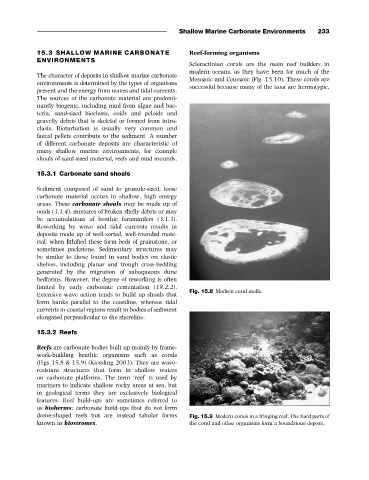
                 Extensive wave action tends to build up shoals that  Fig. 15.8 Modern coral atolls.
                 form banks parallel to the coastline, whereas tidal
                 currents in coastal regions result in bodies of sediment
                 elongated perpendicular to the shoreline.
                 15.3.2 Reefs

                 Reefs are carbonate bodies built up mainly by frame-
                 work-building benthic organisms such as corals
                 (Figs 15.8 & 15.9) (Kiessling 2003). They are wave-
                 resistant structures that form in shallow waters
                 on carbonate platforms. The term ‘reef’ is used by
                 mariners to indicate shallow rocky areas at sea, but
                 in geological terms they are exclusively biological
                 features. Reef build-ups are sometimes referred to
                 as bioherms: carbonate build-ups that do not form
                 dome-shaped reefs but are instead tabular forms  Fig. 15.9 Modern corals in a fringing reef. The hard parts of
                 known as biostromes.                         the coral and other organisms form a boundstone deposit.

