


Page 250 - Sedimentology and Stratigraphy
P. 250
Types of Carbonate Platform  237


                                                              documented being carbonate ramps, which are
                                                              gently sloping platforms, and rimmed shelves,
                                                              which are flat-topped platforms bordered by a rim
                                                              formed by a reef or carbonate sand shoal. The tectonic
                                                              setting influences the characteristics of carbonate
                                                              platforms (Bosence 2005), with the largest occurring
                                                              on passive continental margins (24.2.4) while smaller
                                                              platforms form on localised submarine highs such as
                                                              fault blocks in extensional settings (24.2) and on salt
                                                              diapirs (18.1.4). The different types of carbonate plat-
                                                              form can sometimes occur associated with each other:
                                                              an isolated platform may be a carbonate ramp on one
                                                              side and a rimmed shelf on the other and one form
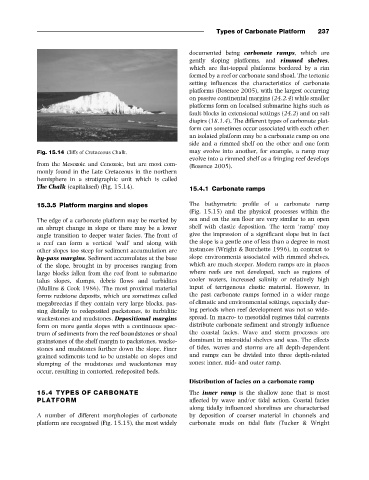
                 Fig. 15.14 Cliffs of Cretaceous Chalk.       may evolve into another, for example, a ramp may
                                                              evolve into a rimmed shelf as a fringing reef develops
                 from the Mesozoic and Cenozoic, but are most com-  (Bosence 2005).
                 monly found in the Late Cretaceous in the northern
                 hemisphere in a stratigraphic unit which is called
                 The Chalk (capitalised) (Fig. 15.14).        15.4.1 Carbonate ramps

                 15.3.5 Platform margins and slopes           The bathymetric profile of a carbonate ramp
                                                              (Fig. 15.15) and the physical processes within the
                 The edge of a carbonate platform may be marked by  sea and on the sea floor are very similar to an open
                 an abrupt change in slope or there may be a lower  shelf with clastic deposition. The term ‘ramp’ may
                 angle transition to deeper water facies. The front of  give the impression of a significant slope but in fact
                 a reef can form a vertical ‘wall’ and along with  the slope is a gentle one of less than a degree in most
                 other slopes too steep for sediment accumulation are  instances (Wright & Burchette 1996), in contrast to
                 by-pass margins. Sediment accumulates at the base  slope environments associated with rimmed shelves,
                 of the slope, brought in by processes ranging from  which are much steeper. Modern ramps are in places
                 large blocks fallen from the reef front to submarine  where reefs are not developed, such as regions of
                 talus slopes, slumps, debris flows and turbidites  cooler waters, increased salinity or relatively high
                 (Mullins & Cook 1986). The most proximal material  input of terrigenous clastic material. However, in
                 forms rudstone deposits, which are sometimes called  the past carbonate ramps formed in a wider range
                 megabreccias if they contain very large blocks, pas-  of climatic and environmental settings, especially dur-
                 sing distally to redeposited packstones, to turbiditic  ing periods when reef development was not so wide-
                 wackestones and mudstones. Depositional margins  spread. In macro- to mesotidal regimes tidal currents
                 form on more gentle slopes with a continuous spec-  distribute carbonate sediment and strongly influence
                 trum of sediments from the reef boundstones or shoal  the coastal facies. Wave and storm processes are
                 grainstones of the shelf margin to packstones, wacke-  dominant in microtidal shelves and seas. The effects
                 stones and mudstones further down the slope. Finer  of tides, waves and storms are all depth-dependent
                 grained sediments tend to be unstable on slopes and  and ramps can be divided into three depth-related
                 slumping of the mudstones and wackestones may  zones: inner, mid- and outer ramp.
                 occur, resulting in contorted, redeposited beds.
                                                              Distribution of facies on a carbonate ramp
                 15.4 TYPES OF CARBONATE                      The inner ramp is the shallow zone that is most
                 PLATFORM                                     affected by wave and/or tidal action. Coastal facies
                                                              along tidally influenced shorelines are characterised
                 A number of different morphologies of carbonate  by deposition of coarser material in channels and
                 platform are recognised (Fig. 15.15), the most widely  carbonate muds on tidal flats (Tucker & Wright

