


Page 254 - Sedimentology and Stratigraphy
P. 254
Types of Carbonate Platform  241


                 basin. The back-reef facies near to the barrier may
                                                                   Rimmed carbonate shelf
                 experience relatively high wave energy resulting
                 in the formation of grainstones of carbonate sand
                 and skeletal debris reworked from the reef. Further  Scale  Lithology  LIMESTONES  bound   Structures etc  Notes
                                                                             wacke
                 inshore the energy is lower and the deposits are           mud  pack  grain  rud &
                 mainly wackestones and mudstones. However, ooidal
                 and peloidal complexes may also occur in the shelf
                 lagoon and patch reefs can also form. In inner shelf
                 areas with very limited circulation and under condi-                    Reef boundstone
                 tions of raised salinities the fauna tends to be very
                 restricted. In arid regions evaporite precipitation may
                 become prominent in the shelf lagoon if the barrier
                 provides an effective restriction to the circulation of
                 seawater.


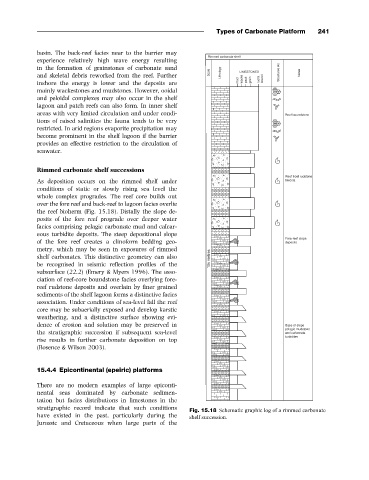
                 Rimmed carbonate shelf successions
                                                                                         Reef front rudstone
                 As deposition occurs on the rimmed shelf under                          breccia
                 conditions of static or slowly rising sea level the
                 whole complex progrades. The reef core builds out
                 over the fore reef and back-reef to lagoon facies overlie
                 the reef bioherm (Fig. 15.18). Distally the slope de-
                 posits of the fore reef prograde over deeper water
                 facies comprising pelagic carbonate mud and calcar-
                 eous turbidite deposits. The steep depositional slope
                                                                                         Fore-reef slope
                 of the fore reef creates a clinoform bedding geo-                       deposits
                 metry, which may be seen in exposures of rimmed
                 shelf carbonates. This distinctive geometry can also  10s metres
                 be recognised in seismic reflection profiles of the
                 subsurface (22.2) (Emery & Myers 1996). The asso-
                 ciation of reef-core boundstone facies overlying fore-
                 reef rudstone deposits and overlain by finer grained
                 sediments of the shelf lagoon forms a distinctive facies
                 association. Under conditions of sea-level fall the reef
                 core may be subaerially exposed and develop karstic
                 weathering, and a distinctive surface showing evi-
                 dence of erosion and solution may be preserved in                       Base of slope
                                                                                         pelagic mudstone
                 the stratigraphic succession if subsequent sea-level                    and carbonate
                                                                                         turbidites
                 rise results in further carbonate deposition on top
                 (Bosence & Wilson 2003).

                 15.4.4 Epicontinental (epeiric) platforms

                 There are no modern examples of large epiconti-
                 nental seas dominated by carbonate sedimen-
                 tation but facies distributions in limestones in the
                 stratigraphic record indicate that such conditions
                                                              Fig. 15.18 Schematic graphic log of a rimmed carbonate
                 have existed in the past, particularly during the  shelf succession.
                 Jurassic and Cretaceous when large parts of the

