


Page 255 - Semiconductor Manufacturing Handbook
P. 255
Geng(SMH)_CH17.qxd  04/04/2005  19:57  Page 17.10


                                               CHEMICAL MECHANICAL POLISHING

                   17.10  WAFER PROCESSING

                               as a carrier. Carriers for these systems are, in general, back referencing. A classic rotational CMP
                               tool is the IPEC (Integrated Process Equipment Corporation)-Westech 372. This single-head system
                               consisted of a single carrier on a gantry, a 22- to 26-in polishing pad, and a wand holding a 75- to
                               100-mm diameter TBW Inc. type pad conditioning disk. These tools also look much like first CMP
                               systems, first offered by Struassbaugh Inc. For basic low-volume CMP work, these tools are quite
                               effective. They are all “wet in, wet out” (WIWO) in configuration and process a single wafer at a
                               time. Loading and unloading of wafers is completed with a water jet and track system, and the wafers
                               remain submerged in the unload station. For basic WCMP and Oxide CMP, these reliable tools work
                               well and can typically be found in the used equipment market or in R&D labs.

                   17.5.2 Multihead Rotational CMP Systems
                               As productivity and defectivity requirements increased, multihead rotational CMP tools were born.
                               This classification of tools has a wide variety of variants. In general, multihead rotational CMP sys-
                               tems are developed for high throughput production applications.
                                 High productivity multihead CMP systems can achieve productivities of greater than 40 wafers
                               per hour (ILD or WCMP). The benchmark multihead, twin platen CMP tool is the Speedfam-IPEC
                               Auriga system. Evolving from the Speedfam Inc. CMP-V platform, the Auriga is a five-head CMP
                               tool that uses one main 32 in diameter platen and a secondary smaller platen for post-CMP buffing.
                               The pad conditioner is a large diamond ring or brush that conditions the pad in between each five-
                               wafer run. At full bore, the Auriga can process more than forty 200 mm wafers per hour (1 min pol-
                               ish at 3000 Å/min) in a production environment. Each head is individually controlled to allow for
                               better process control. Initially a WIWO system, the Auriga evolved into the Auriga C, being the first
                               multihead tool to offer an integrated wafer cleaning system. The Auriga was the throughput king for
                               many years, and was mimicked by the three-head Straussbagh Symphony platform. Other two-and
                               three-head CMP tools, like those offered by Ibarra hit the market later using up the three polishing
                               platens to increase process flexibility.

                   17.5.3 Multiplaten CMP Systems
                               The lack of process flexibility, for example, polishing a lot of 22 wafers versus 25, limited the Auriga
                               and Symphony platforms to simple high-volume CMP processes. Though fast, the Auriga also had
                               reliability problems and could not be extended to multistep, multichemistry CMP processes like Cu
                               CMP. This weakness of multihead single-platen tools allowed multiplaten rotational systems, like
                               those offered by Peter Wolters, Ibarra of Japan, and Applied Materials Inc., to capture the CMP
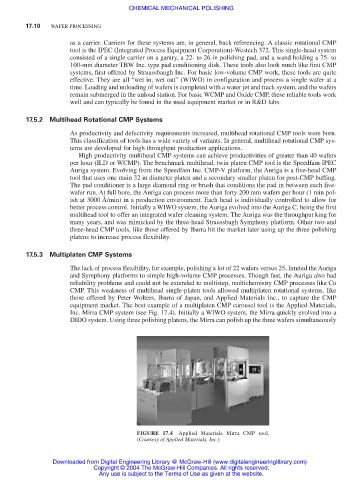
                               equipment market. The best example of a multiplaten CMP carousel tool is the Applied Materials,
                               Inc. Mirra CMP system (see Fig. 17.4). Initially a WIWO system, the Mirra quickly evolved into a
                               DIDO system. Using three polishing platens, the Mirra can polish up the three wafers simultaneously


                                                 FIGURE 17.4  Applied Materials Mirra CMP tool.
                                                 (Courtesy of Applied Materials, Inc.)


                          Downloaded from Digital Engineering Library @ McGraw-Hill (www.digitalengineeringlibrary.com)
                                     Copyright © 2004 The McGraw-Hill Companies. All rights reserved.
                                       Any use is subject to the Terms of Use as given at the website.

