


Page 251 - Separation process principles 2
P. 251
216  Chapter 6  Absorption and Stripping of Dilute Mixtures


                                         Vapor
                                                                                                             drag
                                                                               ( 1
                                                                          Fb = pV p g, buoyancy  /

                                                                                   Liquid    I
                                                                                   droplet:
                                                                                  density, p,
                                                                                 diameter, 4
                                                                                           IFg = pL (%).#
                                                                                                        gravity


                                                                                          Vapor:
                                                                                        density, pv
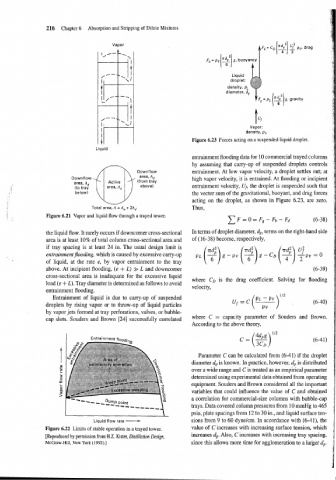
                                                                     Figure 6.23 Forces acting on a suspended liquid droplet.
                                   Liquid
                                                                     entrainment flooding data for 10 commercial trayed columns
                                                                     by  assuming that  carry-up of  suspended droplets controls
                                  0
                                                   area, Ad
                           Downflow               Downflow           entrainment. At low vapor velocity, a droplet settles out; at
                                                                     high vapor velocity, it is entrained. At flooding or incipient
                           area, Ad     Active    (from tray
                            (to tray   area, A,    above)            entrainment velocity, Uf, the droplet is suspended such that
                            below)                                   the vector sum of the gravitational, buoyant, and drag forces
                                                                     Thus,
                                  Total area, A =A,  + 2Ad           acting on  the  droplet, as shown in Figure 6.23, are zero.
                  Figure 6.21  Vapor and liquid flow through a trayed tower.


                  the liquid flow. It rarely occurs if downcomer cross-sectional   In terms of droplet diameter, dp, terms on the right-hand side
                  area is at least 10% of total column cross-sectional area and   of (16-38) become, res~eclivel~,
                  if  tray  spacing is at least 24 in. The usual design limit is
                  entrainmentJooding,  which is caused by excessive carry-up
                  of  liquid,  at  the rate  e, by  vapor entrainment to  the tray
                  above. At incipient flooding, (e + L) >>  L and downcomer                                     (6-39)
                  cross-sectional area is inadequate for the excessive liquid
                                                                     where  CD is  the  drag  coefficient.  Solving  for  flooding
                  load (e + L). Tray diameter is determined as follows to avoid
                                                                     velocity,
                  entrainment flooding.
                                 "
                    Entrainment  of  liquid is due to  carry-up of  suspended
                  droplets by  rising vapor or to throw-up of  liquid particles
                  by vapor jets formed at tray perforations, valves, or bubble-
                  cap slots. Souders and Brown  [24] successfully correlated   where   = capacity  parameter  of   and  Brown.
                                                                     According to the above theory,


                                                                       Parameter C can be calculated from (6-41) if  the droplet
                                                                     diameter dp is known. In practice, however, dp is distributed
                                                                     over a wide range and C is treated as an empirical parameter
                                                                     determined using experimental data obtained from operating
                                                                     equipment. Souders and Brown considered all the important
                                                                     variables that could influence the value of  C and obtained
                                                                     a correlation for commercial-size columns with bubble-cap
                                                                     trays. Data covered column pressures from 10 mmHg to 465
                                  Liquid flow rate -                 psia, plate spacings from 12 to 30 in., and liquid surface ten-
                                                                     sions from 9 to 60 dynelcm. In accordance with (6-41), the
                 Figure 6.22  Limits of  stable operation in a trayed tower.   value of C increases with increasing surface tension, which
                 [Reproduced by permission from H.Z. Kister, Distillation Design,   increases dp. Also, C increases with increasing tray spacing,
                 McGraw-Hill, New York (1992).]                      since this allows more time for agglomeration to a larger dp.

