


Page 250 - Separation process principles 2
P. 250
6.6  Tray Diameter, Pressure Drop, and Mass Transfer  215


                                                          EXAMPLE 6.4

                                                          Assume that the column diameter for the absorption operation of
                                                          Example 6.1 is 3 ft. If the overall stage efficiency, E,,  is 30% for the
               Downcomer                                  absorption of ethyl alcohol, estimate the average Murphree vapor
                                                          efficiency, EMV, and the possible range of the Murphree vapor-point
                                                          efficiency,  Eov.


                                                          SOLUTION
                                                          For Example 6.1, the system is dilute in ethyl alcohol, the  main
               Column wall
                                                          component undergoing mass transfer. Therefore, the equilibrium
                                                          and  operating lines are essentially straight, and (6-37) can be ap-
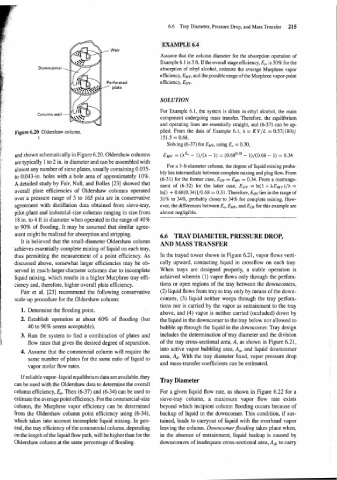
       Figure 6.20  Oldershaw column.                     plied. From  the  data of  Example  6.1, A  = KV/L = 0.57(180)/
               \                                          151.5 = 0.68.
                                                            Solving (6-37) for EMv, using E,  = 0.30,

       and shown schematically in Figure 6.20. Oldershaw columns
       are typically 1 to 2 in. in diameter and can be assembled with
                                                            For a 3-ft-diameter column, the degree of  liquid mixing proba-
       almost any number of sieve plates, usually containing 0.035-
                                                          bly lies intermediate between complete mixing and plug flow. From
      to 0.043-in. holes with a hole area of  approximately 10%.
                                                          (6-3 1) for the former case, Eov = EMv = 0.34. From a rearrange-
      A detailed study by Fair, Null, and Bolles [23] showed that
                                                          ment  of  (6-32) for the  latter  case,  Eov = In(1 + AEMV)/A =
      overall  plate  efficiencies  of  Oldershaw columns  operated   In[l + 0.68(0.34)]/0.68 = 0.3 1. Therefore, Eovlies in the range of
      over a pressure range of  3 to  165 psia are in conservative   31% to 34%, probably closer to 34% for complete mixing. How-
      agreement  with  distillation data obtained from sieve-tray,   ever, the differences between E,,  EMV, and EoV for this example are
      pilot-plant and industrial-size columns ranging in size from   almost negligible.
       18 in. to 4 ft in diameter when operated in the range of 40%
      to 90% of  flooding. It may be  assumed that similar agree-
      ment might be realized for absorption and stripping.   6.6  TRAY DIAMETER, PRESSURE DROP,
         It is believed that the small-diameter Oldershaw column
                                                          AND MASS TRANSFER
      achieves essentially complete mixing of liquid on each tray,
      thus permitting the measurement of  a point  efficiency. As   In the trayed tower shown in Figure 6.21, vapor flows verti-
      discussed above, somewhat larger efficiencies may be  ob-   cally upward, contacting liquid in crossflow on each tray.
      served in much-larger-diameter columns due to incomplete   When  trays  are  designed  properly,  a  stable  operation  is
      liquid mixing, which results in a higher Murphree tray effi-   achieved wherein (1) vapor flows only through the perfora-
      ciency and, therefore, higher overall plate efficiency.   tions or open regions of the tray between the downcomers,
         Fair et al.  [23] recommend  the  following conservative   (2) liquid flows from tray to tray only by means of the down-
      scale-up procedure for the Oldershaw column:        comers, (3) liquid neither weeps through the tray  perfora-
                                                          tions nor is carried by the vapor as entrainment to the tray
         1.  Determine the flooding point.
                                                          above, and (4) vapor is neither carried (occluded) down by
         2.  Establish  operation  at  about  60%  of  flooding  (but   the liquid in the downcomer to the tray below nor allowed to
           40 to 90% seems acceptable).                   bubble up through the liquid in the downcomer. Tray design
         3.  Run  the system to  find a combination of plates and   includes the determination of tray diameter and the division
           flow rates that gives the desired degree of separation.   of the tray cross-sectional area, A, as shown in Figure 6.21,
                                                          into active vapor bubbling area, A,,  and liquid downcomer
         4.  Assume that the commercial column will require the
                                                          area, Ad. With the tray diameter fixed, vapor pressure drop
           same number of plates for the same ratio of liquid to
                                                          and mass-transfer coefficients can be estimated.
           vapor molar flow rates.
         If reliable vapor-liquid  equilibrium data are available, they
                                                          Tray Diameter
      can be used with the Oldershaw data to determine the overall
      column efficiency, E,.  Then (6-37) and (6-34) can be used to   For a given liquid flow rate, as shown in Figure 6.22 for a
      estimate the average point efficiency. For the commercial-size   sieve-tray  column,  a  maximum  vapor  flow  rate  exists
      column, the Murphree vapor efficiency can be  determined   beyond which incipient column flooding occurs because of
      from the Oldershaw column point  efficiency using  (6-34),   backup of liquid in the downcomer. This condition, if  sus-
      which takes into account incomplete liquid mixing. In gen-   tained, leads to carryout of liquid with the overhead vapor
      eral, the tray efficiency of the commercial column, depending   leaving the column. Downcomerffooding  takes place when,
      on the length of the liquid flow path, will be higher than for the   in the absence of entrainment, liquid backup is caused by
      Oldershaw column at the same percentage of flooding.   downcomers of inadequate cross-sectional area, Ad, to carry

