


Page 245 - Separation process principles 2
P. 245
210  Chapter 6  Absorption and Stripping of Dilute Mixtures


                   The  correlating  parameter,  suggested  by  Edmister,  is
                   Ki MLp~/p~, where:

                      Ki = F-value of species being absorbed or stripped
                      ML = molecular weight of the liquid, IbAbmol
                      p~ = viscosity of the liquid, cP
                      p~  = density of the liquid, lb/ft3
                   Thus, the correlating parameter has the units of CP-ft3/lbmol.
                   A reasonable fit to the 33 data points used by O'Connell is
                   given by the empirical equation

                          log  E,  = 1.597 - 0.199 log  -
                                                  (K:pL)


                   The average and maximum deviations of (6-23) for the 33 data
                   points  of  Figure 6.15 are  16.3% and  157%, respectively.
                   More than 50% of the data points, including points for the
      I            highest- and lowest-observed efficiencies, are predicted to           unsatisfactory operation
                                                                            0
     I             within 10%.
     1
                      The 33 data points in Figure 6.15 cover a wide range of
     I             conditions:                                                           Liquid flow rate, gallrnin
    1                     Column diameter:       2 in. to 9 ft
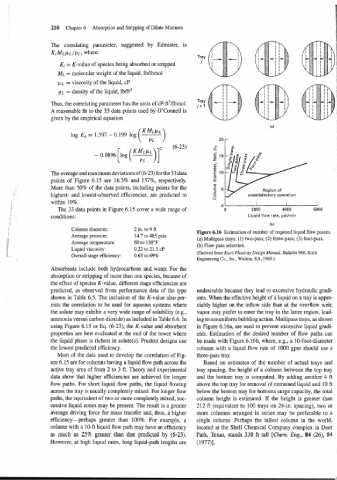
    :                                                                  Figure 6.16  Estimation of number of required liquid flow passes.
                          Average pressure:      14.7 to 485 psia
                                                                       (a) Multipass trays: (1) two-pass; (2) three-pass; (3) four-pass.
                          Average temperature:   60 to 138'F
                                                                       (b) Flow pass selection.
                          Liquid viscosity:      0.22 to 21.5 cP
                                                                       (Derived from Koch Flexitray Design Manual, Bulletin 960, Koch
                          Overall stage efficiency:   0.65 to 69%
                                                                       Engineering Co., Inc., Wichita, KA, 1960.)
                   Absorbents include both  hydrocarbons and water. For the
                   absorption or stripping of more than one species, because of
                   the effect of species K-value, different stage efficiencies are
                   predicted, as observed from performance data of  the type   undesirable because they lead to excessive hydraulic gradi-
                   shown in Table 6.5. The inclusion of the K-value also per-   ents. When the effective height of a liquid on a tray is appre-
                   mits the correlation to be used for aqueous systems where   ciably higher on the inflow side than at the overflow weir,
                   the solute may exhibit a very wide range of solubility (e.g.,   vapor may prefer to enter the tray in the latter region, lead-
                   ammonia versus carbon dioxide) as included in Table 6.6. In   ing to nonuniform bubbling action. Multipass trays, as shown
                   using Figure 6.15 or Eq. (6-23), the K-value and absorbent   in Figure 6.16a, are used to prevent excessive liquid gradi-
                   properties are best evaluated at the end of the tower where   ents. Estimation of  the  desired number of  flow paths  can
                   the liquid phase is richest in solute(s). Prudent designs use   be made with Figure 6.16b, where, e.g., a 10-foot-diameter
                   the lowest predicted efficiency.                    column with a liquid flow rate of  1000 gpm should use a
                     Most of the data used to develop the correlation of Fig-   three-pass tray.
                   ure 6.15 are for columns having a liquid flow path across the   Based on estimates of  the number of  actual  trays  and
                   active tray area of from 2 to 3 ft. Theory and experimental   tray spacing, the height of a column between the top tray
                   data show that higher efficiencies are achieved for longer   and the bottom tray is computed. By  adding another 4 ft
                   flow paths. For short liquid flow paths, the liquid flowing   above the top tray for removal of entrained liquid and 10 ft
                   across the tray is usually completely mixed. For longer flow   below the bottom tray for bottoms surge capacity, the total
                   paths, the equivalent of two or more completely mixed, suc-   column height  is estimated.  If  the height  is  greater  than
                   cessive liquid zones may be present. The result is a greater   212 ft (equivalent to  100 trays on 24-in. spacing), two or
                   average driving force for mass transfer and, thus, a higher   more columns  arranged in series may  be  preferable  to a
                   efficiency-perhaps   greater  than  100%. For  example,  a   single  column.  Perhaps  the  tallest  column  in  the  world,
                   column with a 10-ft liquid flow path may have an efficiency   located at the Shell Chemical Company complex in Deer
                   as  much  as  25% greater  than  that  predicted  by  (6-23),   Park, Texas, stands 338 ft tall  [Chem. Eng,, 84 (26), 84
                   However, at high liquid rates, long liquid-path lengths are   (1977)l.

