


Page 242 - Separation process principles 2
P. 242
6.5  Stage Efficiency  207


                                                          using those methods. Except when temperature changes sig-
                                                          nificantly from stage to stage, the assumption that vapor and
                                                          liquid phases leaving a stage are at the same temperature is
                                                          often reasonable. The  assumption of  equilibrium with  re-
                                                          spect to mass transfer, however, is not often reasonable and,
                                                          for streams leaving a stage, vapor-phase mole fractions are
                                                          not related to liquid-phase mole fractions simply by thermo-
                                                          dynamic K-values. To determine the actual number of plates,
                                  A  Ethylbenzene
                                                          the number of  equilibrium stages must be  adjusted with a
                                  w  Benzene
                                  0 Toluene               stage eflciency (plate eflciency or tray eficiency).
                                                            Stage  efficiency concepts  are  applicable to  devices  in
                                                          which the phases are contacted and then separated, that is,
                                                          when discrete stages can be identified. This is not the case
               I       Number of equilibrium stages
                                                          for packed columns or continuous-contact devices. For these,
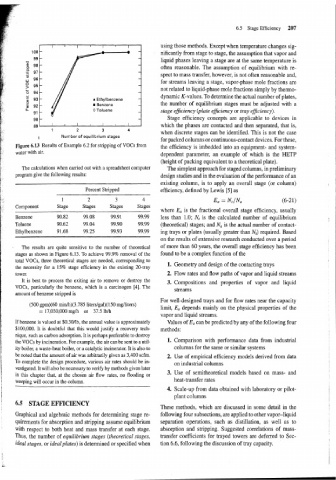
       Figure 6.13  Results of Example 6.2 for stripping of VOCs from   the efficiency is imbedded into an equipment- and system-
       water with air.
                                                          dependent parameter, an  example of  which  is  the  HETP
                                                          (height of packing equivalent to a theoretical plate).
         The calculations when carried out with a spreadsheet computer   The simplest approach for staged columns, in preliminary
       program give the following results:                design studies and in the evaluation of the performance of an
                                                          existing column, is to apply an  overall stage (or column)
                                Percent Stripped          efficiency, defined by Lewis [5] as

                       1        2         3         4
       Component     Stage    Stages    Stages    Stages
                                                          where Eo is the fractional overall stage efficiency, usually
       Benzene       90.82     99.08    99.91     99.99   less than  1.0; N, is the  calculated number of  equilibrium
       Toluene       90.62     99.04    99.90     99.99   (theoretical) stages; and Nu is the actual number of contact-
       Ethylbenzene   91.68    99.25    99.93     99.99   ing trays or plates (usually greater than N,) required. Based
                                                          on the results of extensive research conducted over a period
         The  results  are quite  sensitive to  the  number  of  theoretical   of more than 60 years, the overall stage efficiency has been
       stages as shown in Figure 6.13. To  achieve 99.9% removal of  the   found to be a complex function of the
       total VOCs, three theoretical stages are needed, corresponding to
       the  necessity for  a  15% stage efficiency in  the  existing  20-tray   1. Geometry and design of the contacting trays
       tower.                                               2.  Flow rates and flow paths of vapor and liquid streams
         It  is best  to  process the  exiting air to remove or destroy the
                                                            3.  Compositions  and  properties  of  vapor  and  liquid
       VOCs,  particularly  the benzene, which is  a carcinogen [4]. The
                                                               streams
       amount of benzene stripped is
                                                          For well-designed trays and for flow rates near the capacity
                                                          limit, Eo depends mainly on the physical properties of the
                                                          vapor and liquid streams.
       If  benzene is valued at $0.30/lb, the annual value is approximately   Values of Eo can be predicted by any of the following four
       $100,000. It is  doubtful that this  would justify  a recovery tech-   methods:
       nique, such as carbon adsorption. It is perhaps preferable to destroy
       the VOCs by incineration. For example, the air can be sent to a util-   1. Comparison  with  performance data  from  industrial
       ity boiler, a waste-heat boiler, or a catalytic incinerator. It is also to   columns for the same or similar systems
       be noted that the amount of air was arbitrarily given as 3,400 scfm.   2.  Use of empirical efficiency models derived from data
       TO complete the design procedure, various air rates should be in-   on industrial columns
       vestigated. It will also be necessary to verify by methods given later
       in  this  chapter that, at the  chosen  air flow  rates, no  flooding or   3.  Use  of  semitheoretical models  based  on  mass-  and
       weeping will occur in the column.                       heat-transfer rates
                                                            4.  Scale-up from data obtained with laboratory or pilot-
                                                               plant columns
       6.5  STAGE EFFICIENCY
                                                          These methods, which are discussed in some detail in the
       Graphical and algebraic methods for determining stage re-   following four subsections, are applied to other vapor-liquid
       quirements for absorption and stripping assume equilibrium   separation  operations,  such  as  distillation,  as  well  as  to
       with  respect to both heat and  mass transfer at each stage.   absorption and  stripping. Suggested correlations of  mass-
       Thus, the number of equilibrium stages  (theoretical stages,   transfer coefficients for trayed towers are deferred to Sec-
       ideal stages, or ideal plates) is determined or specified when   tion 6.6, following the discussion of tray capacity.

