


Page 238 - Separation process principles 2
P. 238
6.3  Graphical Equilibrium-Stage Method for Trayed Towers  203


       Note that the operating line can terminate at the equilibrium
                                                                      (a)                   (b)
       line, as for operating line 4, but cannot cross it because that
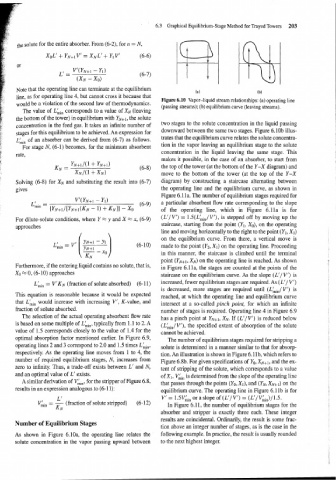
                                                          Figure 6.10 Vapor-liquid  stream relationships: (a) operating line
       would be a violation of the second law of thermodynamics.
                                                          (passing streams); (b) equilibrium curve (leaving streams).
         The value of Lk,  corresponds to a value of XN (leaving
       the bottom of the tower) in equilibrium with YN+l, the solute
                                                          two stages to the solute concentration in the liquid passing
       concentration in the feed gas. It takes an infinite number of
                                                          downward between the same two stages. Figure 6.10b illus-
       stages for this equilibrium to be achieved. An expression for
                                                          trates that the equilibrium curve relates the solute concentra-
       Lk,  of  an  absorber can be  derived from (6-7) as follows.
                                                          tion in the vapor leaving an equilibrium stage to the solute
         For stage N,  (6-1) becomes, for the minimum absorbent
                                                          concentration in  the  liquid  leaving  the  same  stage.  This
       rate,
                                                          makes it possible, in the case of an absorber, to start from
                                                          the top of the tower (at the bottom of the Y-X  diagram) and
                                                          move to the bottom of  the tower (at the top of  the  Y-X
 k
       Solving (6-8) for XN and  substituting the result into (6-7)   diagram) by  constructing  a  staircase  alternating between
       gives                                              the operating line and  the equilibrium curve, as  shown in
                                                          Figure 6.11a. The number of equilibrium stages required for
                                                          a particular absorbent flow rate corresponding to the slope
                                                          of  the  operating  line,  which  in  Figure  6.11a  is  for
 i                                                        (Lf/ V')  = 1.5(LAn/ V'),  is stepped off by  moving up the
       For dilute-solute conditions, where Y x y and X w x, (6-9)
                                                          staircase, starting from the point (Yl, Xo), on the operating
       approaches
                                                          line and moving horizontally to the right to the point (Y1, XI)
                                                          on  the equilibrium curve. From  there, a  vertical move  is
                                                          made to the point (Yz, X1) on the operating line. Proceeding
                                                          in this manner, the  staircase is climbed until the terminal
                                                          point (YN+~, XN) on the operating line is reached. As shown
       Furthermore, if the entering liquid contains no solute, that is,
                                                          in Figure 6.11a, the stages are counted at the points of the
       Xo w 0, (6- 10) approaches                         staircase on the equilibrium curve. As the slope (L'l V')  is
             L',,   = VfKN (fraction of solute absorbed)  (6-1 1)   increased, fewer equilibrium stages are required. As (L'l V')
                                                          is  decreased, more  stages are required until  (LA,/  V')  is
       This equation is reasonable because it would be expected
                                                          reached, at which the operating line and equilibrium curve
       that LLi,  would increase with increasing V',  K-value, and   intersect at  a  so-called pinch  point,  for which  an  infinite
       fraction of solute absorbed.                       number of stages is required. Operating line 4 in Figure 6.9
         The selection of the actual operating absorbent flow rate
                                                          has a pinch point at YN+l, XN. If (Lf/ V')  is reduced below
       is based on some multiple of L;,,   typically from 1.1 to 2. A   (L',,/V1),  the specified extent of  absorption of  the solute
       value of  1.5 corresponds closely to the value of  1.4 for the   cannot be achieved.
       optimal absorption factor mentioned earlier. In Figure 6.9,   The number of equilibrium stages required for stripping a
       operating lines 2 and 3 correspond to 2.0 and 1.5 times LA,,   solute is determined in a manner similar to that for absorp-
       respectively. As  the operating line moves from  1 to 4, the
                                                          tion. An illustration is shown in Figure 6.11 b, which refers to
       number  of  required equilibrium stages, N, increases from   Figure 6.8b. For given specifications of Yo, XN+1, and the ex-
       zero to infinity. Thus, a trade-off exists between L'  and N,   tent of stripping of the solute, which corresponds to a value
       and an optimal value of L' exists.                 of X1, VA,  is determined from the slope of the operating line
         A similar derivation of VA,,  for the stripper of Figure 6.8,   that passes through the points (Yo, XI), and (YN, XN+i) on the
       results in an expression analogous to (6-1 1):     equilibrium curve. The operating line in Figure 6.11b is for

                     L'                                   V'  = 1.5VAn or a slope of (L'l V')  = (L'/VA,)/1.5.
               Vkin = - (fraction of solute stripped)   (6- 12)   In Figure 6.11, the number of equilibrium stages for the
                     KN
                                                          absorber and  stripper is exactly three each. These integer
                                                          results are coincidental. Ordinarily, the result is some frac-
       Number of Equilibrium Stages
                                                          tion above an integer number of stages, as is the case in the
       As  shown  in  Figure  6.10a, the  operating line  relates the   following example. In practice, the result is usually rounded
       solute concentration in  the vapor passing upward between   to the next highest integer.

