


Page 234 - Separation process principles 2
P. 234
6.1  Equipment  199


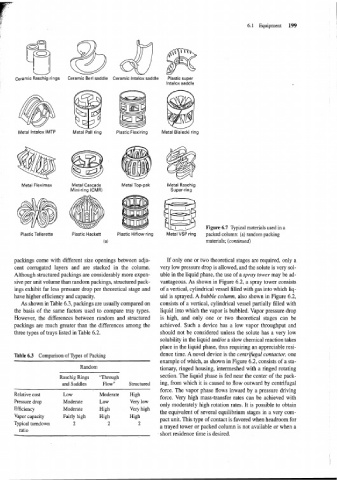
       Ceramic Raschig rings   Ceramic Berl saddle  Ceramic lntalox saddle   Plastic super
                                                            lntalox saddle


        Metal lntalox IMTP   Metal Pall ring   Plastic Flexiring   Metal Bialecki ring


         Metal Fleximax    Metal Cascade    Metal Top-pak   Metal Raschig
                          Mini-ring (CMR)                    Super-ring


                                                                          Figure 6.7  Typical materials used in a
         Plastic Tellerette   Plastic Hackett   Plastic Hiflow ring   Metal VSP ring   packed column: (a) random packing
                                      (a)                                 materials; (continued)


      paclungs come with different size openings between adja-   If only one or two theoretical stages are required, only a
      cent  corrugated  layers  and  are  stacked  in  the  column.   very low pressure drop is allowed, and the solute is very sol-
      Although structured packings are considerably more expen-   uble in the liquid phase, the use of a spray tower may be ad-
      sive per unit volume than random packings, structured pack-   vantageous. As shown in Figure 6.2, a spray tower consists
      ing~ exhibit far less pressure drop per theoretical stage and   of a vertical, cylindrical vessel filled with gas into which liq-
      have higher efficiency and capacity.                uid is sprayed. A bubble column, also shown in Figure 6.2,
         As shown in Table 6.3, packings are usually compared on   consists of a vertical, cylindrical vessel partially filled with
      the basis of  the  same factors used  to compare tray  types.   liquid into which the vapor is bubbled. Vapor pressure drop
      However, the  differences between  random  and  structured   is  high,  and  only  one  or  two  theoretical  stages  can  be
      packings are much greater than the differences among the   achieved. Such a device has  a low vapor throughput and
      three types of trays listed in Table 6.2.           should not be considered unless the solute has a very low
                                                          solubility in the liquid and/or a slow chemical reaction takes
                                                          place in the liquid phase, thus requiring an appreciable resi-
      Table 6.3  Comparison of Types of Packing           dence time. A novel device is the centrifugal contactor, one
                                                          example of which, as shown in Figure 6.2, consists of a sta-
                              Random                      tionary, ringed housing, intermeshed with a ringed rotating

                      Raschig Rings   "Through            section. The liquid phase is fed near the center of the pack-
                       and Saddles   Flow"     Stmctured   ing, from which it is caused to flow outward by centrifugal
                                                          force. The vapor phase flows inward by  a pressure driving
      Relative cost     Low         Moderate   High
                                                          force. Very  high mass-transfer rates can be  achieved with
      Pressure drop     Moderate    Low        Very low
                                                          only moderately high rotation rates. It is possible to obtain
      Efficiency        Moderate    High       Very high
                                                          the equivalent of several equilibrium stages in a very com-
      Vapor capacity    Fairly high   High     High
                                                          pact unit. This type of contact is favored when headroom for
      Typical turndown     2           2          2       a trayed tower or packed column is not available or when a
        ratio
                                                          short residence time is desired.

