


Page 229 - Separation process principles 2
P. 229
194  Chapter 6  Absorption and Stripping of Dilute Mixtures


                           For a packed column, define the "height equivalent to a theoretical (equilibrium) stage (plate)," HETP, and
                           explain how it and the number of equilibrium stages differ from "height of a transfer unit," HTU, and "number
                           of transfer units," NTU, respectively.
                           Explain differences between "loading point" and "flooding point" in a packed column.
                           Estimate packed height, packed-column diameter, and pressure drop across the packing.
                           Estimate HTU from correlations of mass-transfer coefficients.
                           Explain how the number of theoretical stages is computed for concentrated solutions in which equilibrium and
                           operating lines are curved.


                 Industrial Example                                  in this example is greater than the energy of  condensation
                                                                     liberated from the absorption of acetone.
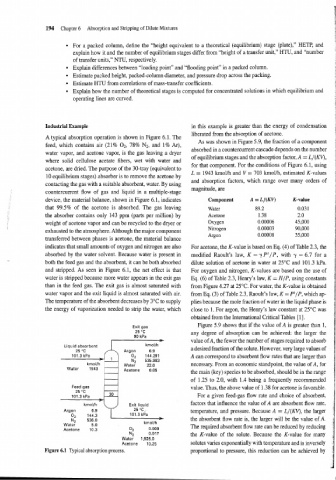
                 A typical absorption operation is shown in Figure 6.1. The
                                                                       As was shown in Figure 5.9, the fraction of a component
                 feed,  which  contains air  (21%  02, 78%  N2,  and  1% Ar),
                                                                     absorbed in a countercurrent cascade depends on the number
                 water vapor, and acetone vapor, is the gas leaving a dryer
                                                                     of equilibrium stages and the absorption factor,  A = L/(KV),
                 where  solid  cellulose  acetate  fibers,  wet  with  water  and
                                                                     for that component. For the conditions of Figure 6.1, using
                 acetone, are dried. The purpose of the 30-tray (equivalent to
                                                                     L = 1943 kmolh and V = 703 kmolh, estimated K-values
                  10 equilibrium stages) absorber is to remove the acetone by
                                                                     and  absorption factors, which  range  over many  orders of
                 contacting the gas with a suitable absorbent, water. By using
                                                                     magnitude, are
                 countercurrent flow  of  gas  and  liquid in  a  multiple-stage
                 device, the material balance, shown in Figure 6.1, indicates   Component   A = L/(KV)   K-value
                 that  99.5%  of  the  acetone  is  absorbed. The  gas  leaving   Water    89.2           0.03  1
                 the absorber contains only  143 ppm (parts per million) by   Acetone       1.38          2.0
                 weight of acetone vapor and can be recycled to the dryer or   Oxygen       0.00006      45,000
                                                                           Nitrogen         0.00003      90,000
                 exhausted to the atmosphere. Although the major component
                                                                           Argon            0.00008      35,000
                 transferred between phases is acetone, the material balance
                 indicates that small amounts of oxygen and nitrogen are also   For acetone, the K-value is based on Eq. (4) of Table 2.3, the  4
                 absorbed by the water solvent. Because water is present in   modified Raoolt's  law,  K = y PSI P, with  y  = 6.7 for  a   1
                 both the feed gas and the absorbent, it can be both absorbed   dilute solution of  acetone i11 water at 25OC and  101.3 kPa.
                 and  stripped. As  seen in  Figure 6.1, the net effect is that   For oxygen and nitrogen, K-values are based on the use of
                 water is stripped because more water appears in the exit gas   Eq. (6) of Table 2.3, Henry's law, K = HIP, using constants
                 than in the feed gas. The exit gas is almost saturated with   from Figure 4.27 at 25OC. For water, the K-value is obtained
                 water vapor and the exit liquid is almost saturated with air.   from Eq. (3) of Table 2.3, Raoult's law, K = PS/P, which ap-
                 The temperature of the absorbent decreases by 3°C to supply   plies because the mole fraction of water in the liquid phase is
                 the energy of vaporization needed to strip the water, which   close to 1. For argon, the Henry's law constant at 25OC was
                                                                     obtained from the International Critical Tables [I].
                                                                       Figure 5.9 shows that if the value of A is greater than 1,
                                                Exit gas
                                                 25 "C               any  degree of  absorption can be  achieved: the  larger the
                                                 90 kPa
                                                          >          value ofA, the fewer the number of stages required to absorb
                        Liquid absorbent             kmollh
                            25 "C            Araon    6.9            a desired fraction of the solute. However, very large values of
                           101.3 kPa            0,   144.291         A can correspond to absorbent flow rates that are larger than
                                                N2   535.983
                                krnollh      Water   22.0            necessary. From an economic standpoint, the value of A, for
                         Water   1943        Acetone   0.05
                                                                     the main (key) species to be absorbed, should be in the range
                                                                     of  1.25 to  2.0,  with  1.4 being  a frequently recommended
                           Feed gas                                  value. Thus, the above value of 1.38 for acetone is favorable.
                                                                       For a given feed-gas i3ow  rate and choice of  absorbent,
                               krnollh         Exit liquid           factors that influence the value of A are absorbent flow rate,
                        Argon                    25 "C,              temperature, and pressure. Because A  = L/(KV),  the larger
                                144.3          101.3 kPa
                                536.0                                the absorbent flow rate is, the larger will be the value of A.
                        Water     5.0               krnollh          The required absorbent flow rate can be reduced by reducing
                        Acetone   10.3         02     0.009
                                               N 2    0.017          the K-value  of  the  solute. Because the  K-value for  many
                                            Water   1,926.0
                                            Acetone   10.25          solutes varies exponentially with temperature and is inversely
                 Figure 6.1 Typical absorption process.              proportional to pressure, this reduction can be achieved by

