


Page 232 - Separation process principles 2
P. 232
6.1  Equipment  197


       -r--


         Plate
           Vapor flow              Vapor flow                  Vapor flow   ,
              (a)                     (b)                         (c)


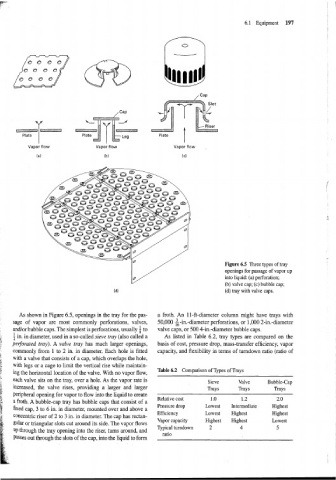
                                                                                 Figure 6.5  Three types of tray
                                                                                 openings for passage of  vapor up
                                                                                 into liquid: (a) perforation;
                                                                                 (b) valve cap; (c) bubble cap;
                                                                                 (d) tray with valve caps.


        As shown in Figure 6.5, openings in the tray for the pas-   a  froth. An  11-ft-diameter column might  have  trays  with
      sage  of  vapor  are  most  commonly  perforations,  valves,   50,000 A-in.-diameter perforations, or 1,000 2-in.-diameter
      and/or bubble caps. The simplest is perforations, usually  to   valve caps, or 500 4-in.-diameter bubble caps.
        in. in diameter, used in a so-called sieve tray (also called a   As listed  in  Table 6.2, tray  types are compared on the
      perforated  tray). A valve  tray  has  much  larger  openings,   basis of cost, pressure drop, mass-transfer efficiency, vapor
      commonly from  1 to 2 in. in diameter. Each hole is fitted   capacity, and flexibility in terms of turndown ratio (ratio of
      with a valve that consists of a cap, which overlaps the hole,
      with legs or a cage to limit the vertical rise while maintain-
                                                         Table 6.2  Comparison of Types of Trays
      ing the horizontal location of the valve. With no vapor flow,
      each valve sits on the tray, over a hole. As the vapor rate is       Sieve      Valve     Bubble-Cap
      mcreased,  the  valve  rises,  providing  a  larger  and  larger     Trays      Trays       Trays
      Peripheral opening for vapor to flow into the liquid to create
                                                         Relative cost      1 .O       1.2         2.0
      a froth. A bubble-cap tray has bubble caps that consist of a
                                                         Pressure drop    Lowest   Intermediate   Highest
      fixed cap, 3 to 6 in. in diameter, mounted over and above a
                                                         Efficiency       Lowest   Highest        Highest
      concentric riser of 2 to 3 in. in diameter. The cap has rectan-
                                                         Vapor capacity   Highest   Highest       Lowest
      gular or triangular slots cut around its side. The vapor flows
                                                         Typical turndown   2         4            5
      UP through the tray opening into the riser, turns around, and
                                                           ratio
      Passes out through the slots of the cap, into the liquid to form

