


Page 233 - Separation process principles 2
P. 233
198  Chapter 6  Absorption and Stripping of Dilute Mixtures


                  maximum  to  minimum  vapor  capacity).  At  the  limiting   gas to flow mainly up the center of the column, thus greatly
                  vapor capacity, jlooding  of  the column occurs because of   reducing  the extent of vapor-liquid  contact. In that case, a  i
                  excessive entrainment of liquid droplets in the vapor causing   liquid red~stributor should be installed.   i
                  the liquid flow rate to exceed the capacity of the downcomer   Commercial packing materials include random (dumped)   '  '
                  and, thus, go back up the column. At low vapor rates, weep-   packings,  some  of  which  are  shown  in  Figure  6.7a,  and
                  ing of  liquid through  the tray  openings or vapor pulsation   structured (also called arranged, ordered, or stacked pack-
                  becomes excessive. Because of their low relative cost, sieve   ing~), some of which are shown in Figure 6.7b. Among the
                  trays  are preferred  unless  flexibility  is  required,  in which   random packings, which are poured into the column, are the
                  case valve trays are best.  Bubble-cap trays,  which exist in   old  (1895-1950)  ceramic Raschig  rings  and Berl  saddles,
                  many pre-1950 installations, are rarely specified for new in-   which are seldom specified for new installations. They have
                  stallations, but may be preferred when the amount of liquid   been largely replaced by metal and plastic Pall rings, metal
                  holdup on a tray must be controlled to provide adequate res-   Bialecki rings, and ceramic Intalox saddles, which provide
                  idence time for a chemical reaction or when weeping must   more surface area for mass transfer, a higher flow capacity,
                  be prevented.                                      and  a  lower  pressure  drop.  More  recently,  through-flow
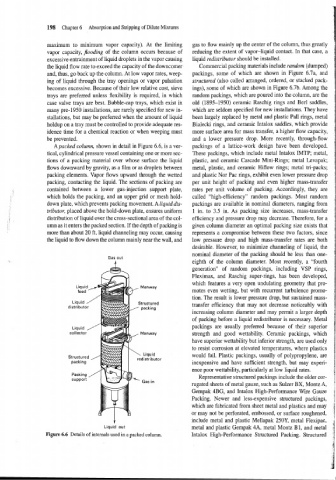
                    Apacked column, shown in detail in Figure 6.6, is a ver-   paclungs  of  a  lattice-work  design  have  been  developed.
                  tical, cylindrical pressure vessel containing one or more sec-   These packings,  which include metal Intalox IMTP; metal,
                  lions of  a paclung  material  over whose  surface the liquid   plastic,  and  ceramic Cascade Mini-Rings; metal  Levapak;
                  flows downward by gravity, as a film or as droplets between   metal,  plastic,  and  ceramic  Hiflow rings;  metal  tri-packs;
                  packing  elements. Vapor flows upward through the wetted   and plastic Nor Pac rings, exhibit even lower pressure drop
                  packing,  contacting the liquid. The sections of packing  are   per  unit  height  of  paclung  and  even higher  mass-transfer
                  contained  between  a  lower  gas-injection  support  plate,   rates  per  unit  volume  of  packing.  Accordingly,  they  are
                  which holds the paclung, and an upper grid or mesh hold-   called  "high-efficiency"  random  packings.  Most  random
                  down plate, which prevents packing movement. A liquid dis-   paclungs  are available in nominal diameters, ranging  from
                  tributor, placed above the hold-down plate, ensures uniform   1 in.  to  3.5  in.  As  packing  size  increases,  mass-transfer
                  distribution of liquid over the cross-sectional area of the col-   efficiency and pressure drop may decrease. Therefore, for a
                  umn as it enters the packed section. If the depth of packing is   given column diameter an optimal packing  size exists that
                  more than about 20 ft, liquid channeling may occur, causing   represents  a compromise between  these  two factors, since
                  the liquid to flow down the column mainly near the wall, and   low  pressure  drop  and  high  mass-transfer  rates  are  both
                                                                     desirable.  However,  to minimize  channeling  of  liquid, the
                                                                     nominal  diameter of  the paclung  should be less  than  one-
                                        Gas out                      eighth  of  the  column  diameter.  Most  recently,  a  "fourth
                                      A                              generation"  of  random  packings,  including  VSP  rings,
                                                                     Fleximax,  and  Raschig  super-rings,  has  been  developed,
                                                                     which features a very  open undulating  geometry  that pro-
                                                                     motes even wetting,  but with recurrent  turbulence  promo-
                                                                     tion. The result is lower pressure drop, but sustained mass-
                                                                     transfer  efficiency  that  may  not  decrease  noticeably  with
                                                                     increasing column diameter and may permit a larger depth
                                                                     of packing before a liquid redistributor  is necessary. Metal
                                                                     paclungs  are  usually  preferred  because  of  their  superior
                                                                     strength  and  good  wettability.  Ceramic  packings,  which
                                                                     have superior wettability but inferior strength, are used only
                                                                     to reslst corrosion at elevated temperatures, where plastics
                                                                     would fail. Plastic packings,  usually of polypropylene, are
                                                                     inexpensive  and  have  sufficient strength, but  may  experi-
                                                                     ence poor wettability, particularly at low liquid rates.
                                                                        Representative structured packings include the older cor-
                                                                     rugated sheets of metal gauze, such as Sulzer BX, Montz A,
                                                                     Gempak 4BG, and Intalox High-Performance  Wire Gauze
                                                                     Packing.  Newer  and  less-expensive  structured  packings,
                                                                     which are fabricated from sheet metal and plastics and may
                                                                     or may not be perforated, embossed, or surface roughened,
                                                                     include metal  and  plastic  Mellapak 250Y, metal  Flexipac,
                                      Liquid  out                    metal and plastic Gempak 4A, metal Montz B1, and metal
                  Figure 6.6  Details of intemals used in a packed column.   Intalox  High-Performance  Structured Paclung.  Structured

