


Page 236 - Separation process principles 2
P. 236
6.3  Graphical Equilibrium-Stage Method for Trayed Towers  201


          5.  Minimum absorbent (stripping agent)  flow  rate  and   absorbent (stripping agent) flow rate exists that corresponds
            actual absorbent (stripping agent) flow rate as a multi-   to an infinite number of countercurrent equilibrium contacts
            ple of the minimum rate needed to make the separation   between the gas and liquid phases. In every design problem
                                                          involving flow rates of  the absorbent (stripping agent) and
          6.  Number of  equilibrium stages and  stage efficiency
                                                          number of stages, a trade-off exists between the number of
          7. Heat effects and need for cooling (heating)
                                                          equilibrium stages and the absorbent (stripping agent) flow
          8.  Type of absorber (stripper) equipment       rate at rates greater than the minimum value. Graphical and
          9.  Height of absorber (stripper)               analytical methods for computing the minimum flow rate and
                                                          this trade-off are developed in the following sections for a
         10. Diameter of absorber (stripper)
                                                          mixture that  is  dilute in  the  solute(s). For  this essentially
         The ideal absorbent should (a) have a high solubility for   isothermal case, the energy balance can be ignored. As dis-
       the solute(s) to minimize the need for absorbent, (b) have a   cussed in Chapters 10 and  11, computer-aided methods are
       low volatility to reduce the loss of absorbent and facilitate   best used for concentrated mixtures, where multicomponent
       separation of absorbent from solute(s), (c) be stable to max-   phase-equilibrium and mass-transfer effects can become com-
       imize absorbent life and reduce absorbent makeup require-   plicated and it is necessary to consider the energy balance.
       ment, (d) be noncorrosive to permit use of common materi-
       als of construction, (e) have a low viscosity to provide low
                                                          6.3  GRAPHICAL EQUILIBRIUM-STAGE
       pressure drop and high mass- and heat-transfer rates, (f) be
       nonfoaming when contacted with the gas so as to make it un-   METHOD FOR TRAYED TOWERS
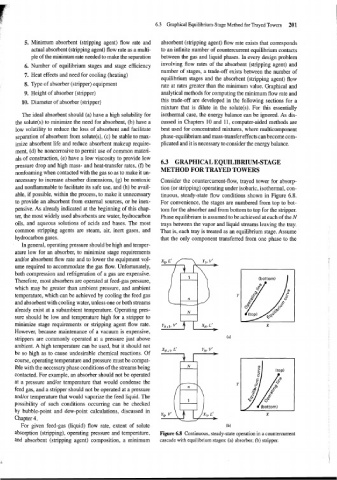
       necessary to increase absorber dimensions, (g) be nontoxic   Consider the countercurrent-flow, trayed tower for absorp-
       and nonflammable to facilitate its safe use, and (h) be avail-   tion (or stripping) operating under isobaric, isothermal, con-
       able, if possible, within the process, to make it unnecessary   tinuous, steady-state flow conditions shown in Figure 6.8.
       to provide an absorbent from external sources, or be inex-   For convenience, the stages are numbered from top to bot-
       pensive. As already indicated at the beginning of this chap-   tom for the absorber and from bottom to top for the stripper.
       ter, the most widely used absorbents are water, hydrocarbon   Phase equilibrium is assumed to be achieved at each of the N
       oils, and  aqueous solutions of  acids and bases. The most   trays between the vapor and liquid streams leaving the tray.
       common  stripping agents are  steam, air,  inert  gases, and   That is, each tray is treated as an equilibrium stage. Assume
       hydrocarbon gases.                                 that the only component transferred from one phase to the
         In general, operating pressure should be high and temper-
       ature low for an absorber, to minimize stage requirements
       and/or absorbent flow rate and to lower the equipment vol-
       ume required to accommodate the gas flow. unfortunately,
       both compression and refrigeration of a gas are expensive.
       Therefore, most absorbers are operated at feed-gas pressure,
       which may be greater than  ambient pressure, and  ambient
       temperature, which can be achieved by cooling the feed gas
       and absorbent with cooling water, unless one or both streams
       already exist at a subambient temperature. Operating pres-
       sure should be  low  and  temperature high for a stripper to
       minimize stage requirements or  stripping agent flow  rate.
       However, because maintenance of  a vacuum is expensive,
       strippers are commonly operated at  a pressure just  above
       ambient. A high temperature can be used, but it should not
       be  so high as to cause undesirable chemical reactions. Of
       course, operating temperature and pressure must be compat-
       ible with the necessary phase conditions of the streams being
       contacted. For example, an absorber should not be operated
       at  a pressure and/or temperature that  would condense the
       feed gas, and a stripper should not be operated at a pressure                    )/)
       and/or temperature that would vaporize the feed liquid. The
       possibility  of  such  conditions  occurring  can  be  checked
                                                                                              (bottom)
       by  bubble-point and dew-point  calculations, discussed in
       Chapter 4.
         For  given  feed-gas (liquid) flow  rate,  extent  of  solute
       absorption (stripping), operating pressure and temperature,   Figure 6.8  Continuous, steady-state operation in a countercurrent
       and  absorbent  (stripping agent)  composition, a  minimum   cascade with equilibrium stages: (a) absorber; (b) stripper.

