


Page 239 - Separation process principles 2
P. 239
204  Chapter 6  Absorption and Stripping of Dilute Mixtures


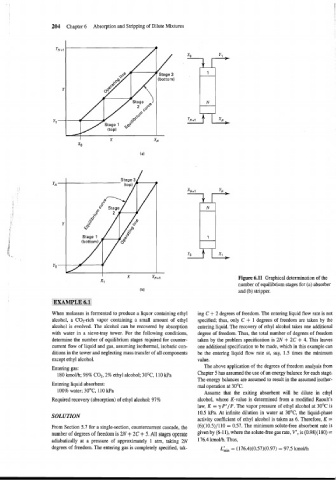
                                                                                     Figure 6.11  Graphical determination of the
                                                                                     number of equilibrium stages for (a) absorber
                                                                                     and (b) stripper.


                    When molasses is fermented to produce a liquor containing ethyl   ing C + 2 degrees of freedom. The entering liquid flow rate is not
                    alcohol,  a  C02-rich  vapor  containing  a  small  amount  of  ethyl   specified; thus, only C + 1 degrees of freedom are taken by the
                    alcohol is evolved.  The  alcohol can be recovered by  absorption   entering liquid. The recovery of ethyl alcohol takes one additional
                    with  water  in  a  sieve-tray  tower.  For  the  following  conditions,   degree of freedom. Thus, the total number of degrees of freedom
                    determine the number of equilibrium  stages required for counter-   taken by the problem specification is 2N + 2C + 4. This leaves
                    current flow of liquid and gas, assuming isothermal, isobaric con-   one additional specification to be made, which in this example can
                    ditions in the tower and neglecting mass transfer of all components   be  the  entering  liquid  flow rate  at,  say,  1.5 times  the  minimum
                    except ethyl alcohol.                              value.
                                                                         The above application of the degrees of freedom analysis from
                    Entering gas:
                      180 kmollh; 98% COz, 2% ethyl alcohol; 30°C, 110 kPa   Chapter 5 has assumed the use of an energy balance for each stage.
                                                                       The energy balances are assumed to result in the assumed isother-
                    Entering liquid absorbent:
                                                                       mal operation at 30°C.
                      100% water; 30°C, 110 kPa                          Assume  that  the  exiting  absorbent  will  be  dilute  in  ethyl
                    Required recovery (absorption) of ethyl alcohol: 97%   alcohol,  whose K-value is determined  from a  modified Raoult's
                                                                       law, K = y PS/P. The vapor pressure of ethyl alcohol at 30°C is
                                                                       10.5 kPa. At infinite dilution  in water  at 30°C, the liquid-phase
                    SOLUTZON
                                                                       activity coefficient of ethyl alcohol is taken as 6. Therefore, K =
                    From Section 5.7 for a single-section, countercurrent cascade, the   (6)(10.5)/110  = 0.57. The minimum solute-free absorbent rate is
                    number of degrees of freedom is 2N t 2C t 5. All stages operate   given by (6-ll), where the solute-free gas rate, V',  is (0.98)(180) =
                    adiabatically  at  a  pressure  of  approximately  1  atm,  taking  2N   176.4 kmolth. Thus,
                    degrees of freedom. The entering gas is completely specified, tak-

