


Page 243 - Separation process principles 2
P. 243
208  Chapter 6  Absorption and Stripping of Dilute Mixtures


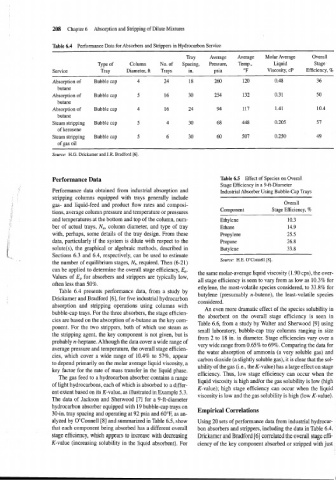
                    Table 6.4  Performance Data for Absorbers and Strippers in Hydrocarbon Service
                    --
                                                                   Tray    Average   Average   Molar Average   Overall
                                    Type of    Column     No. of   Spacing,   Pressure,   Temp.,   Liquid       Stage
                    Service          Tray     Diameter, ft   Trays   in.     psia      OF       Viscosity, cP   Efficiency, %

                    Absorption of   Bubble cap    4        24       18       260       120        0.48           36
                      butane
                    Absorption of   Bubble cap    5        16       30       254       132        0.31           50
                      butane
                    Absorption of   Bubble cap    4        16       24        94       117        1.41           10.4
                      butane
                    Steam stripping   Bubble cap   5        4       30        68       448        0.205          57
                      of kerosene
                    Steam stripping   Bubble cap   5        6       30        60       507        0.250          49
                      of gas oil

                    Source:  H.G. Drickamer and J.R. Bradford [6].


                    Performance Data                                           Table 6.5  Effect of Species on Overall
                                                                               Stage Efficiency in a 9-ft-Diameter
                    Performance  data  obtained from industrial  absorption  and   Industrial Absorber Using Bubble-Cap Trays
                    stripping  columns  equipped  with  trays  generally  include
                                                                                                      Overall
                    gas- and  liquid-feed and  product  flow rates and  composi-
                                                                               Component         Stage Efficiency, %
                    tions, average column pressure and temperature or pressures
                                                                               -
                                                                                    -
                    and temperatures at the bottom and top of the column, num-   Ethylene              10.3
                    ber of  actual trays, N,,  column diameter, and type of  tray   Ethane             14.9
                    with, perhaps, some details of  the tray design. From these   Propy leile          25.5
                    data, particularly if the system is dilute with respect to the   Propane           26.8
                    solute(s), the  graphical or algebraic  methods, described  in   Butylene          33.8
                    Sections 6.3 and 6.4, respectively, can be used to estimate
                                                                               Source:  H.E. O'Connell[8].
                    the number of equilibrium stages, N,, required. Then (6-21)
                    can be applied to determine the overall stage efficiency, E,.   the same molar-average liquid viscosity (1.90 cps), the over-
                    Values  of  E,  for absorbers and strippers are typically  low,
                                                                       all stage efficiency is seen to vary from as low as 10.3% for
                    often less than 50%.
                                                                       ethylene, the most-volatile species considered, to 33.8% for
                      Table  6.4 presents  performance  data, from  a  study  by
                                                                       butylene  (presumably n-butene),  the  least-volatile  species
                    Drickamer and Bradford [6], for five industrial hydrocarbon
                                                                       considered.
                    absorption  and  stripping  operations  using  columns  with
                                                                          An even more dramatic effect of the species solubility in
                    bubble-cap trays. For the three absorbers, the stage efficien-
                                                                       the  absorbent  on  the  overall  stage  efficiency  is  seen  in
                    cies are based on the absorption of n-butane as the key com-
                                                                       Table 6.6, from a study by Walter and Sherwood [9] using
                    ponent. For the two strippers, both  of  which use  steam as
                                                                       small  laboratory, bubble-cap  tray  columns ranging  in  size
                    the stripping agent, the key component is not given, but is
                                                                       from 2 to 18 in. in diameter. Stage efficiencies vary over a
                    probably n-heptane. Although the data cover a wide range of
                                                                       very wide range from 0.65% to 69%. Comparing the data for
                    average pressure and temperature, the overall stage efficien-
                                                                       the water absorption  of  ammonia (a very  soluble gas) and
                    cies, which  cover  a  wide range of  10.4% to 57%, appear
                                                                       carbon dioxide (a slightly soluble gas), it is clear that the sol-
                    to depend primarily on the molar average liquid viscosity, a
                                                                       ubility of the gas (i.e., the K-value) has a large effect on stage
                    key factor for the rate of  mass transfer in the liquid phase.
                                                                       efficiency. Thus, low  stage efficiency can occur when  the
                      The gas feed to a hydrocarbon absorber contains a range
                                                                       liquid viscosity is high andlor the gas solubility is low (high
                    of light hydrocarbons, each of which is absorbed to a differ-
                                                                       K-value); high  stage efficiency can  occur when  the liquid
                    ent extent based on its K-value, as illustrated in Example 5.3.
                                                                       viscosity is low and the gas solubility is high (low K-value).
                    The data of  Jackson and Sherwood [7] for a 9-ft-diameter
                    hydrocarbon absorber equipped with 19 bubble-cap trays on   Empirical Correlations
                    30-in. tray spacing and operating at 92 psia and 60°F, as an-
                    alyzed by 0'~onnell[8] and summarized in Table 6.5, show   Using 20 sets of performance data from industrial hydrocar-
                    that each component being absorbed has a different overall   bon absorbers and strippers, including the data in Table 6.4,
                    stage efficiency, which appears to increase with decreasing   Drickamer and Bradford [6] correlated the overall stage effi-
                    K-value  (increasing solubility  in the liquid  absorbent). For   ciency of the key component absorbed or stripped with just

