


Page 235 - Separation process principles 2
P. 235
200  Chapter 6  Absorption and Stripping of Dilute Mixtures


                                                                                                                       1
                                                         Flexicerarnic


                             Mellapak                         Flexipac


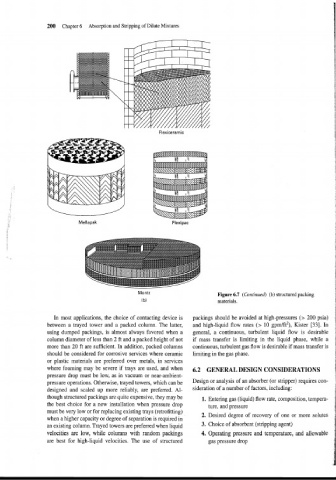
                                                  Montz                       Figure 6.7  (Continued) (b) structured packing
                                                   (b)                        materials.


                    In most applications, the choice of contacting device is   paclungs should be avoided at high-pressures (> 200 psia)
                  between  a trayed  tower  and  a packed  column.  The latter,   and high-liquid  flow rates  (> 10 gpm/ft2), aster [33]. In
                  using  dumped packings,  is almost always favored  when  a   general,  a  continuous,  turbulent  liquid  flow  is  desirable
                  column diameter of less than 2 ft and a packed height of not   if  mass  transfer  is  limiting  in  the  liquid  phase,  while  a
                  more than 20 ft are sufficient. In addition, packed columns   continuous, turbulent gas flow is desirable if mass transfer is
                  should be considered for corrosive services where ceramic   limiting in the gas phase.
                  or plastic  materials  are preferred  over  metals,  in  services
                  where foaming may be severe if  trays are used, and when   6.2  GENERAL DESIGN CONSIDERATIONS
                  pressure drop must be low, as in vacuum or near-ambient-
                  pressure operations. Otherwise, trayed towers, which can be   Design or analysis of an absorber (or stripper) requires con-
                  designed  and  scaled  up  more  reliably,  are  preferred.  Al-   sideration of a number of factors, including:
                  though structured packings are quite expensive, they may be   1. Entering gas (liquid) flow rate, composition, tempera-
                  the best  choice for a new  installation when  pressure  drop
                                                                           ture, and pressure
                  must be very low or for replacing existing trays (retrofitting)
                                                                        2.  Desired degree of recovery  of  one or more solutes
                  when a higher capacity or degree of separation is required in
                  an existing column. Trayed towers are preferred when liquid   3.  Choice of absorbent (stripping agent)
                  velocities  are  low,  while columns with  random packings   4, Operating pressure and temperature, and allowable
                  are  best  for  high-liquid  velocities.  The  use  of  structured   gas pressure drop

