


Page 237 - Separation process principles 2
P. 237
202  Chapter 6  Absorption and Stripping of  Dilute Mixtures


                   other is the solute. For application to an absorber, let:   the liquid, the solute concentration in the gas is always greater
                                                                      than the equilibrium value, thus providing the driving force
                      L'  = molar flow rate of solute-free absorbent   for mass transfer of solute from the gas to the liquid. For the  4
                      V'  = molar flow rate of solute-free gas (carrier gas)   stripper, the operating line lies below the equilibrium line for 1
                      X = mole ratio of solute to solute-free absorbent in the   the opposite reason. For the coordinate systems in Figure 6.8,  I
                          liquid                                       the operating lines are straight with a slope of L'/  V'.   4
                                                                                                                       1
                      Y = mole ratio of solute to solute-free gas in the vapor   For an absorber, the terminal point of the operating line at  :
                                                                       the top of the tower is fixed at Xo by the amount of solute, if  1
                   Note that with these definitions, values of L' and V'  remain   any, in the entering absorbent, and the specified degree of  4
                   constant through the tower, assuming no vaporization of ab-
                                                                       absorption of the solute, which fixes the value of  Y1  in  the  '
                   sorbent into carrier gas or absorption of carrier gas by liquid.   leaving  gas.  The  terminal  point  of  the  operating  line  at  "
                   For the  solute at  any  equilibrium stage, n, the K-value is   the bottom of the tower depends on  YN+~ and the slope of
                   given in terms of X and Y as:                      the operating line and, thus, the flow rate, L',  of solute-free
                                                                       absorbent.


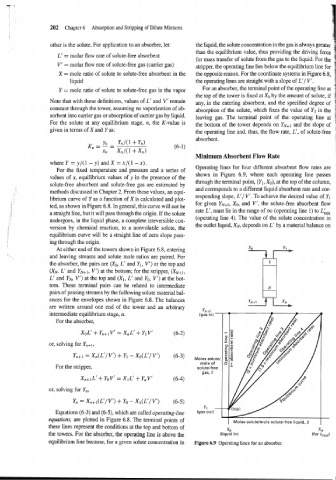
                                                                      Minimum Absorbent Flow Rate
                   where Y  = y/(l  - y) and X = x/(l - x).
                                                                       Operating lines for four different absorbent flow rates are
                     For the  fixed temperature and  pressure and a series of
                   values of x, equilibrium values of y in the presence of  the   shown  in  Figure  6.9,  where  each  operating  line  passes
                                                                      through the terminal point, (Yl, Xo), at the top of the column,
                   solute-free absorbent and  solute-free gas are estimated by
                                                                      and corresponds to a different liquid absorbent rate and cor-
                   methods discussed in Chapter 2. From these values, an equi-
                                                                      responding slope, L'/  V'.  To achieve the desired value of Yl
                   librium curve of Y as a function of X is calculated and plot-
                                                                      for given  YN+~, XO, and  V',  the solute-free absorbent flow
                   ted, as shown in Figure 6.8. In general, this curve will not be
                                                                      rate L',  must lie in the range of oo (operating line 1) to L&,
                   a straight line, but it will pass through the origin. If the solute
                                                                       (operating line 4). The value of the solute concentration in
                   undergoes, in the liquid phase, a complete irreversible con-
                                                                      the outlet liquid, XN, depends on L' by a material balance on
                   version  by  chemical reaction, to  a  nonvolatile solute, the
                   equilibrium curve will be a straight line of zero slope pass-
                   ing through the origin.
                     At either end of the towers shown in Figure 6.8, entering
                   and leaving streams and solute mole ratios are paired. For
                   the absorber, the pairs are (Xo, L'  and Yl, V')  at the top and
                   (XN, L'  and YN+l, V') at the bottom; for the stripper, (XN+1,
                   L'  and YN, V') at the top and (XI, L'  and Yo, V')  at the bot-
                   tom. These  terminal pairs  can  be  related  to  intermediate
                   pairs of passing streams by the following solute material bal-
                   ances for the envelopes shown in Figure 6.8. The balances
                   are written around one end of  the tower  and an  arbitrary
                   intermediate equilibrium stage, n.
                     For the absorber,


                   or, solving for
                           Yn+i   Xn(L1/ V') + Yl  - Xo(L1/ V')   (6-3)
                     For the stripper,


                   or, solving for Yn,
                           Yn  = Xn+i (L'/  V') + Yo  - XI (L'/ V')   (6-5)
                     Equations (6-3) and (6-5), which are called operating-line
                   equations, are plotted in Figure 6.8. The terminal points of                                    I
                                                                                  I  Moles solute/mole solute-free liquid, X
                   these lines represent the conditions at the top and bottom of
                                                                                  xo                              XN
                   the towers. For the absorber, the operating line is above the   (liquid in)                  (for Lmi,)
                   equilibrium line because, for a given solute concentration in   Figure 6.9  Operating lines for an absorber,

