


Page 230 - Separation process principles 2
P. 230
6.0  Instructional Objectives  195


             the temperature and/or increasing the pressure. In-   (a strong base) is used as the absorbent to dissolve an acid gas,
      creasing the pressure also serves to reduce the diameter of the   absorption is accompanied by a rapid and irreversible neutral-
      equipment for a given gas throughput. However, temperature   ization reaction in the liquid phase and the process is referred
      adjustment by feed-gas refrigeration and/or absorbent refrig-   to  as  chemical  absorption  or  reactive  absorption.  More
      eration,  and/or  adjustment of  the  feed-gas pressure by  gas   complex  examples  of  chemical  absorption  are  processes
      compression  can  be  expensive.  For  these  reasons,  the  ab-   for  absorbing  COz  and  H2S  with  aqueous  solutions  of
      sorber in Figure 6.1 operates at near-ambient conditions.   monoethanolamine  (MEA)  and  diethanolamine  (DEA),
        For a stripper, the stripping factor, S = 1/A  = KV/L, is   where a reversible chemical reaction takes place in the liquid
      crucial. To reduce the required flow rate of stripping agent,   phase. Chemical reactions can increase the rate of absorption,
      operation of the stripper at a high temperature and/or a low   increase the absorption capacity of the solvent, increase selec-
      pressure is desirable, with an optimum stripping factor in the   tivity to preferentially dissolve only certain components of the
      vicinity of 1.4.                                   gas, and convert a hazardous chemical to a safe compound.
      -
                                                            In this chapter, trayed and packed-column equipment for
        Absorption  and stripping are technically  mature separa-   conducting absorption and stripping operations is discussed
      tion operations. Design procedures are well developed and   and  fundamental equilibrium-based and  rate-based (mass-
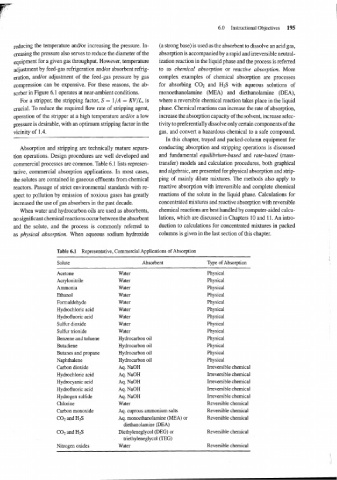
      conlmercial processes are common. Table 6.1 lists represen-   transfer) models and calculation procedures, both graphical
      tative, commercial absorption  applications.  In  most cases,   and algebraic, are presented for physical absorption and strip-
      the solutes are contained in gaseous effluents from chemical   ping  of  mainly dilute mixtures. The methods  also apply to
      reactors. Passage of strict environmental standards with re-   reactive absorption with irreversible and complete chemical
      spect to pollution by emission of noxious gases has greatly   reactions  of the solute in the liquid phase.  Calculations  for
      increased the use of gas absorbers in the past decade.   concentrated mixtures and reactive absorption with reversible
        When water and hydrocarbon oils are used as absorbents,   chemical reactions are best handled by computer-aided calcu-
      no significant chemical reactions occur between the absorbent   lations, which are discussed in Chapters 10 and 11. An intro-
      and  the  solute,  and  the  process  is  commonly  referred  to   duction to calculations for concentrated mixtures in packed
      as physical  absorption. When  aqueous  sodium hydroxide   columns is given in the last section of this chapter.


                     Table 6.1  Representative, Comnlercial Applications of Absorption

                     Solute                        Absorbent              Type of Absorption
                     Acetone               Water                          Physical
                     Acryloiiitrile        Water                          Physical
                     Ammonia               Water                          Physical
                     Ethanol               Water                          Physical
                     Formaldehyde          Water                          Physical
                     Hydrochloric acid     Water                          Physical
                     Hydrofluoric acid     Water                          Physical
                     Sulfur dioxide        Water                          Physical
                     Sulfur trioxide       Water                          Physical
                     Benzene and toluene   Hydrocarbon oil                Physical
                     Butadiene             Hydrocarbon oil                Physical
                     Butanes and propane   Hydrocarbon oil                Physical
                     Naphthalene           Hydrocarbon oil                Physical
                     Carbon dioxide        Aq. NaOH                       Irreversible chemical
                     Hydrochloric acid     Aq. NaOH                       Irreversible chemical
                     Hydrocyanic acid      Aq. NaOH                       Irreversible chemical
                     Hydrofluoric acid     Aq. NaOH                       Irreversible chemical
                     Hydrogen sulfide      Aq. NaOH                       Irreversible chemical
                     Chlorine              Water                          Reversible chemical
                     Carbon monoxide       Aq. cuprous ammonium salts     Reversible chemical
                     C02 and H2S           Aq. monoethanolamine (MEA) or   Reversible chemical
                                             diethanolamine (DEA)
                     C02  and H2S          Diethyleneglycol (DEG) or      Reversible chemical
                                             triethyleneglycol (TEG)
                     Nitrogen oxides       Water                          Reversible chemical

