


Page 203 - Silence in Intercultural Communication
P. 203
190  Silence in Intercultural Communication


             	 	10										think	it’s	true	that	(0.4)	um	female’s
             	 	11										conversation	goes	on	en	on	en	on,=
             	 	12			?:						=heh	[hhh]
             	 	13		Miki:										[be	]cause	they	tend	to	say	(.)	oh
             	 	14										that’s	not	true	but	(this	is	true,)
             	 	15		Lect:				Mm	[hum]
             	 	16		Miki:									[jus]t	like	this,(example	of)/(it’s
             	 	17										like)	this?	(1.2)	yeah.	(0.4)	I	don’t	know,
             	 	18										(0.2)	if	(0.3)	it’s	general	idea	but	(1.8)
             	 	19										ma:le,	(1.4)	like	men,	(.)	really	don’t
             	 	20										that	much	as	(1.0)	do it (0.4) ˚yeah.˚
             	 	21										some	(0.2)	some	men	do	but	(3.2)	I	don’t
             	 	22										know	if-	(.)	I	don’t	know	if	it’s:	cultural
             	 	23										(0.2)	thing or, (1.5)˚(maybe/I don't know)˚
             	 	24										(1.2)
                25    ?:     ˚Mm:::::::.˚
             	 	26										(1.4)
             	 	27		Nakki:			Maybe	it’s	too	much	generalisation	but	I’ve
             	 	28										had	about	twenty	people	(0.3)	like	in	(.)
             	 	29										in	and	out	all	Japanese	guys	they’re	all
             	 	30										really	quiet.	(0.5)	they	won’t	say	anything
             	 	31										unless	you	talk	to	them.
             ->	32										(2.2)	((Nakki	smiles,	gazing	towards
             	 	33										Miki))
             	 	34		Sophia:			Well	I	think	um	(0.6)	men	are	like	(						)
             	 	35										doesn't	capture	(					)(0.5)	what’s
             	 	36										acceptable	to	say	...

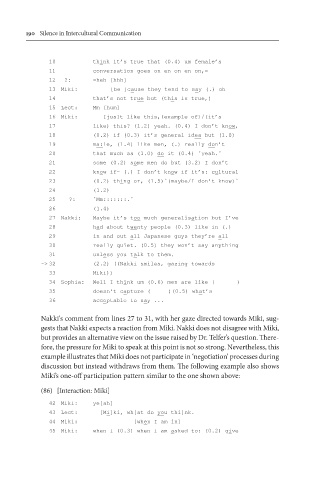
             Nakki's comment from lines 27 to 31, with her gaze directed towards Miki, sug-
             gests that Nakki expects a reaction from Miki. Nakki does not disagree with Miki,
             but provides an alternative view on the issue raised by Dr. Telfer’s question. There-
             fore, the pressure for Miki to speak at this point is not so strong. Nevertheless, this
             example illustrates that Miki does not participate in ‘negotiation’ processes during
             discussion but instead withdraws from them. The following example also shows
             Miki’s one-off participation pattern similar to the one shown above:
             (86)   [Interaction: Miki]

             	 	42		Miki:				ye[ah]
             	 	43		Lect:									[Mi]ki,	wh[at	do	you	thi]nk.
             	 	44		Miki:															[when	I	am	in]
             	 	45		Miki:				when	I	(0.3)	when	I	am	asked	to:	(0.2)	give

