


Page 204 - Silence in Intercultural Communication
P. 204
Chapter 5.  Performance and perceptions of silence  191


             	 	46											my	own	opinion,(0.3)	I	have	to	take	some
             	 	47											time	to	think	(0.5)	what	my	opinion	is,
             	 	48											(0.3)	why		I	(do)	this	(0.7)	argument,
             	 	49											cause	(0.6)		even	when	I	was	writing	(0.3)
             	 	50											something	in	Japan	for	school	(0.2)	work	for
             	 	51											homework,	(0.4)	I	wasn’t	asked	to:	(.)	give
             	 	52											(0.3)	my	opinion.	(0.2)	I	just	(0.2)	could
             	 	53											get	something	from	the	book	what	it
             	 	54											says,	(0.8)	a:nd	um	I	could	say	(0.5)	I
             	 	55											(0.2)	will	agree	or	I	will	not	agree,	but
             	 	56											I	couldn’t	give	much	of	my	opinion	why	I
             	 	57											agree	or	why	I	don’t	agree.(0.8).	so:	I
             	 	58											(0.2)	sometimes still (0.2) find it hard
                59           for me to ˚give my own opinion.˚
             	 	60											(0.5).
             	 	61		Lect:					It’s	also	hard	even	for	Australian	school
             	 	62											kids,	(0.3)	because	(0.3)	the-	the	question
             	 	63											i:s,	okay,	the	kids	give	their	opinions
             	 	64											(0.2)	but	is	your	opinion	(				)	acceptable.
             	 	65											(1.2)	and	are	there	a	whole	set-	set	of
             	 	66											answers	(																)	which	the
             	 	67											teachers	will	accept	and	tho:se	they	won’t
             	 	68											accept.	(1.0)	so	to	produce	that-	(
             	 	69															),	(0.4)	teachers	can	be	forming	the
             	 	70											opinions	of	the	students	by saying	this	is
             	 	71											what’s	acceptable	(										),		so	you
             	 	72											know,	(1.2)	((Lect	facing	the	class))
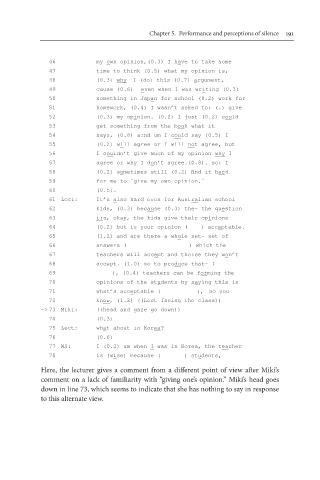
             ->	73		Miki:					((head	and	gaze	go	down))
             	 	74											(0.3)
             	 	75		Lect:					what	about	in	Korea?
             	 	76											(0.6)
             	 	77		WS:							I	(0.2)	um	when	I	was	in	Korea,	the	teacher
             	 	78											is	(wise)	because	(							)	students,
             Here, the lecturer gives a comment from a different point of view after Miki’s
             comment on a lack of familiarity with “giving one’s opinion.” Miki’s head goes
             down in line 73, which seems to indicate that she has nothing to say in response
             to this alternate view.

