


Page 162 - Social Marketing for Public Health Global Trends and Success Stories
P. 162
57977_CH06_final.qxd:Cheng  11/5/09  4:39 PM  Page 135


                                                                  Identifying the Target Audience(s)  135


                     which ranged from choice con-
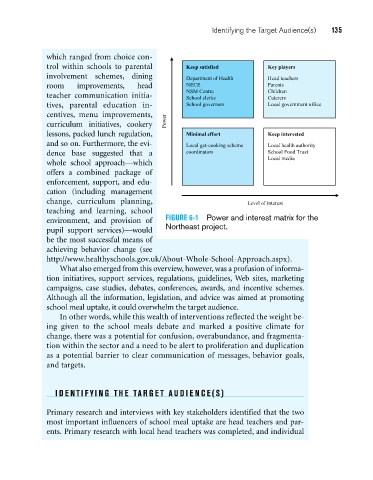
                     trol within schools to parental       Keep satisfied        Key players
                     involvement schemes, dining           Department of Health  Head teachers
                     room    improvements,   head          NECE                  Parents
                                                           NSM Centre            Children
                     teacher communication initia-         School clerks         Caterers
                     tives, parental education in-         School governors      Local government office
                     centives, menu improvements,
                     curriculum initiatives, cookery  Power
                     lessons, packed lunch regulation,     Minimal effort        Keep interested
                     and so on. Furthermore, the evi-      Local get-cooking scheme  Local health authority
                     dence base suggested that a           coordinators          School Food Trust
                                                                                 Local media
                     whole school  approach—which
                     offers a combined  package  of
                     enforcement, support, and edu-
                     cation (including management
                     change, curriculum planning,                          Level of interest
                     teaching and learning, school
                     environment, and provision of   FIGURE 6-1 Power and interest matrix for the
                                                     Northeast project.
                     pupil support services)—would
                     be the most successful means of
                     achieving behavior change (see
                     http://www.healthyschools.gov.uk/About-Whole-School-Approach.aspx).
                        What also emerged from this overview, however, was a profusion of informa-
                     tion initiatives, support services, regulations, guidelines, Web sites, marketing
                     campaigns, case studies, debates, conferences, awards, and incentive schemes.
                     Although all the information, legislation, and advice was aimed at promoting
                     school meal uptake, it could overwhelm the target audience.
                        In other words, while this wealth of interventions reflected the weight be-
                     ing given to the school meals debate and marked a positive climate for
                     change, there was a potential for confusion, overabundance, and fragmenta-
                     tion within the sector and a need to be alert to proliferation and duplication
                     as a potential barrier to clear communication of messages, behavior goals,
                     and targets.


                       ID EN TIF Y IN G  THE TA R GE T A UD IEN C E ( S)


                     Primary research and interviews with key stakeholders identified that the two
                     most important influencers of school meal uptake are head teachers and par-
                     ents. Primary research with local head teachers was completed, and individual

