


Page 260 - Social Marketing for Public Health Global Trends and Success Stories
P. 260
57977_CH10_final.qxd:Cheng  11/5/09  4:43 PM  Page 233


                                             Campaign Strategies (4Ps), Implementation, and Evaluation  233


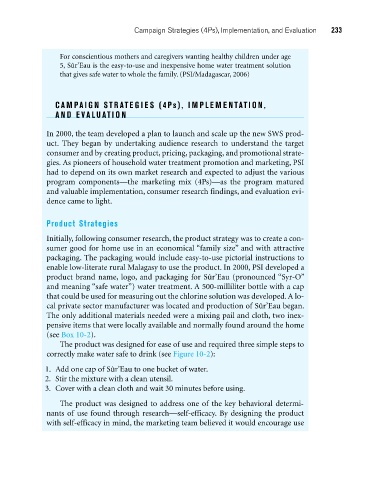
                        For conscientious mothers and caregivers wanting healthy children under age
                        5, Sûr’Eau is the easy-to-use and inexpensive home water treatment solution
                        that gives safe water to whole the family. (PSI/Madagascar, 2006)


                       C A MPA I GN STR ATE GIE S (4Ps ), IMP L EMEN TATI O N ,
                       AN D EVAL UATI O N

                     In 2000, the team developed a plan to launch and scale up the new SWS prod-
                     uct. They began by undertaking audience research to understand the target
                     consumer and by creating product, pricing, packaging, and promotional strate-
                     gies. As pioneers of household water treatment promotion and marketing, PSI
                     had to depend on its own market research and expected to adjust the various
                     program components—the marketing mix (4Ps)—as the program matured
                     and valuable implementation, consumer research findings, and evaluation evi-
                     dence came to light.


                     Product Strategies
                     Initially, following consumer research, the product strategy was to create a con-
                     sumer good for home use in an economical “family size” and with attractive
                     packaging. The packaging would include easy-to-use pictorial instructions to
                     enable low-literate rural Malagasy to use the product. In 2000, PSI developed a
                     product brand name, logo, and packaging for Sûr’Eau (pronounced “Syr-O”
                     and meaning “safe water”) water treatment. A 500-milliliter bottle with a cap
                     that could be used for measuring out the chlorine solution was developed. A lo-
                     cal private sector manufacturer was located and production of Sûr’Eau began.
                     The only additional materials needed were a mixing pail and cloth, two inex-
                     pensive items that were locally available and normally found around the home
                     (see Box 10-2).
                        The product was designed for ease of use and required three simple steps to
                     correctly make water safe to drink (see Figure 10-2):
                    1. Add one cap of Sûr’Eau to one bucket of water.
                    2. Stir the mixture with a clean utensil.
                    3. Cover with a clean cloth and wait 30 minutes before using.
                        The product was designed to address one of the key behavioral determi-
                     nants of use found through research—self-efficacy. By designing the product
                     with self-efficacy in mind, the marketing team believed it would encourage use

