


Page 270 - Social Marketing for Public Health Global Trends and Success Stories
P. 270
57977_CH10_final.qxd:Cheng  11/5/09  4:43 PM  Page 243


                                                                   Summary and Lessons Learned    243


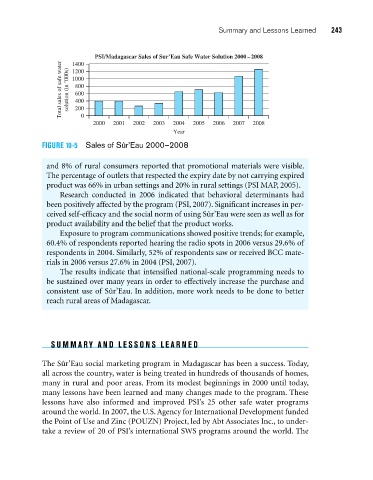
                                  PSI/Madagascar Sales of Sur’Eau Safe Water Solution 2000–2008
                         Total sales of safe water  solution (in ’000s)  1000
                            1400
                            1200
                             800
                             600
                             400
                             200
                              0
                                 2000  2001  2002  2003  2004  2005  2006  2007  2008
                                                       Year
                    FIGURE 10-5  Sales of Sûr’Eau 2000–2008


                     and 8% of rural consumers reported that promotional materials were visible.
                     The percentage of outlets that respected the expiry date by not carrying expired
                     product was 66% in urban settings and 20% in rural settings (PSI MAP, 2005).
                        Research conducted in 2006 indicated that behavioral determinants had
                     been positively affected by the program (PSI, 2007). Significant increases in per-
                     ceived self-efficacy and the social norm of using Sûr’Eau were seen as well as for
                     product availability and the belief that the product works.
                        Exposure to program communications showed positive trends; for example,
                     60.4% of respondents reported hearing the radio spots in 2006 versus 29.6% of
                     respondents in 2004. Similarly, 52% of respondents saw or received BCC mate-
                     rials in 2006 versus 27.6% in 2004 (PSI, 2007).
                        The results indicate that intensified national-scale programming needs to
                     be sustained over many years in order to effectively increase the purchase and
                     consistent use of Sûr’Eau. In addition, more work needs to be done to better
                     reach rural areas of Madagascar.


                      S U M M ARY AN D L E SS O N S L E AR N E D

                    The Sûr’Eau social marketing program in Madagascar has been a success. Today,
                    all across the country, water is being treated in hundreds of thousands of homes,
                    many in rural and poor areas. From its modest beginnings in 2000 until today,
                    many lessons have been learned and many changes made to the program. These
                    lessons have also informed and improved PSI’s 25 other safe water programs
                    around the world. In 2007, the U.S. Agency for International Development funded
                    the Point of Use and Zinc (POUZN) Project, led by Abt Associates Inc., to under-
                    take a review of 20 of PSI’s international SWS programs around the world. The

